Introduction
Algorithmic trading means using a computer program to execute trades automatically, based on a defined set of rules. Instead of watching a screen and clicking buttons, your software monitors the market, identifies opportunities and places orders — faster, more consistently and without emotional interference.
In traditional finance, algorithmic trading has dominated equity and FX markets for years. In crypto, it has become equally central. The same instruments, the same logic, and a market that runs 24 hours a day, 7 days a week — making automation not just attractive, but practical.
This page explains what algo trading actually involves, what you need to get started, and how you can structure your setup — from a fully automated system to a hybrid model where you combine algorithmic execution with manual control in the same interface.
What Algorithmic Trading Actually Means
At its core, an algo trading system does three things:
- Monitors the market — reads price data, order book depth, funding rates, technical indicators or any other signal you define
- Makes a decision — compares live data against your rules and determines whether to buy, sell or do nothing
- Executes the order — sends the trade to an exchange via API, with the size, price and order type you specified
The ”algorithm” is simply the set of rules you write. It can be as simple as ”buy when the 20-period moving average crosses above the 200-period moving average” or as complex as a multi-variable statistical model that incorporates funding rates, order book imbalance and cross-exchange price differentials.
The key distinction from manual trading is consistency: the algorithm follows its rules every time, without hesitation, fatigue or second-guessing.
Why Algo Trading Makes Sense in Crypto
Several structural features of crypto markets make algorithmic trading particularly well suited:
24/7 markets. Crypto never closes. No human trader can monitor markets continuously. An algorithm can.
High volatility creates opportunity. Frequent price swings mean more signals and more edge for systematic strategies — but they also mean that delayed or emotional execution destroys that edge.
Funding rates generate carry. Perpetual futures exchanges pay or charge funding rates every few hours. A systematic strategy can capture this carry in a delta-neutral way — a consistent yield stream that requires continuous monitoring and rebalancing. Not practical manually. Very practical algorithmically.
Fragmented liquidity. The same asset often trades at slightly different prices across exchanges simultaneously. Algorithms can identify and exploit these gaps in milliseconds.
Low barrier to entry. Unlike traditional markets with FIX connectivity requirements and prime broker relationships, crypto exchange APIs are open, REST and WebSocket-based, and accessible with a standard programming environment.
What You Need to Get Started
Getting a basic algo trading setup running in crypto requires four components:
1. An Exchange Account with API Access
Most major exchanges — Hyperliquid, Lighter, Apex, Binance, Bybit, OKX — provide API access as standard. You generate an API key in your account settings, which gives your software permission to read market data and place orders on your behalf.
API keys have configurable permissions: read-only (for data), trading (for placing orders) and withdrawal (never grant this unless strictly necessary). Always restrict permissions to the minimum required.
2. A Programming Environment
Most crypto algo trading is done in Python, which has a mature ecosystem of libraries for data handling, API communication and signal processing. Other common choices include JavaScript/TypeScript (especially for DeFi on-chain interactions) and Rust or C++ for latency-sensitive strategies.
You do not need to be a professional software engineer. A basic understanding of Python and the ability to read and modify existing code is sufficient for most systematic strategies at retail and semi-institutional scale.
Key libraries:
– requests / websockets — for connecting to exchange APIs
– pandas — for working with price and time-series data
– numpy — for numerical calculations
– ccxt — a unified library that supports 100+ exchanges with a single API interface
3. Market Data
Your algorithm needs data to make decisions. There are two main sources:
Live data via WebSocket — exchanges stream real-time price, order book and trade data over WebSocket connections. This is what your algorithm reads during live trading.
Historical data — for backtesting your strategy before running it with real capital. Most exchanges provide REST API endpoints for historical OHLCV (Open, High, Low, Close, Volume) data. Third-party providers (Kaiko, CryptoCompare, Tardis) offer cleaner, more complete datasets for serious backtesting.
4. A Risk Management Layer
No algorithm should run without guardrails. At minimum, your system should enforce:
- Maximum position size — the algorithm cannot exceed a defined exposure limit
- Daily loss limit — if losses exceed a threshold, the algorithm stops trading and alerts you
- Order sanity checks — reject orders with prices far from the current market (prevents runaway bugs)
- Heartbeat monitoring — a watchdog that alerts you if the algorithm stops responding
Risk management is the part most beginners skip. It is the part that determines whether a bug causes a minor inconvenience or a catastrophic loss.
| Component | Minimum Setup | Professional Setup |
|---|---|---|
| Exchange access | One exchange, API key | Multiple exchanges, institutional API tier |
| Programming | Python basics | Python + async, Rust/C++ for latency |
| Market data | Exchange WebSocket (free) | Paid historical data provider (Kaiko, Tardis) |
| Backtesting | Manual / spreadsheet | Full simulation engine with slippage model |
| Risk management | Basic position limits | Automated kill switches, PnL monitoring, alerts |
| Infrastructure | Local PC or laptop | Cloud server (low latency, always-on) |
| Monitoring | Manual checks | Automated alerts (Telegram, email, dashboard) |
How to Structure Your Setup — From Simple to Advanced
Level 1 — Script on Your Laptop
The simplest setup: a Python script running on your personal computer, connecting to one exchange, implementing one strategy. You start it manually, monitor it occasionally, and stop it when you are done.
This is the right starting point. It keeps complexity low and forces you to understand every component. The downside: your laptop going to sleep or losing internet connection stops the strategy.
Level 2 — Cloud Server
Moving your algorithm to a cloud server (a small virtual machine on AWS, Google Cloud or a VPS provider) solves the uptime problem. Your algorithm runs continuously, even when your laptop is off. Costs are modest — a small server runs €5–20 per month.
This is the standard setup for systematic retail traders and small funds running strategies that do not require ultra-low latency.
Level 3 — Multi-Exchange with Full Infrastructure
At this level, your system connects to multiple exchanges simultaneously, runs several strategies in parallel, maintains a real-time risk dashboard, and sends automated alerts when something requires attention. This is the setup used by systematic crypto funds and professional trading desks.
Getting here is a project, not an afternoon. But Level 1 and Level 2 are achievable in days to weeks for anyone with basic programming skills and a clear strategy in mind.
The Hybrid Model — Algorithm and Manual Trading Together
One of the most practical approaches — especially for traders who are building toward full automation — is the hybrid model: running an algorithm and manual trading simultaneously, in the same interface.
Here is what this looks like in practice:
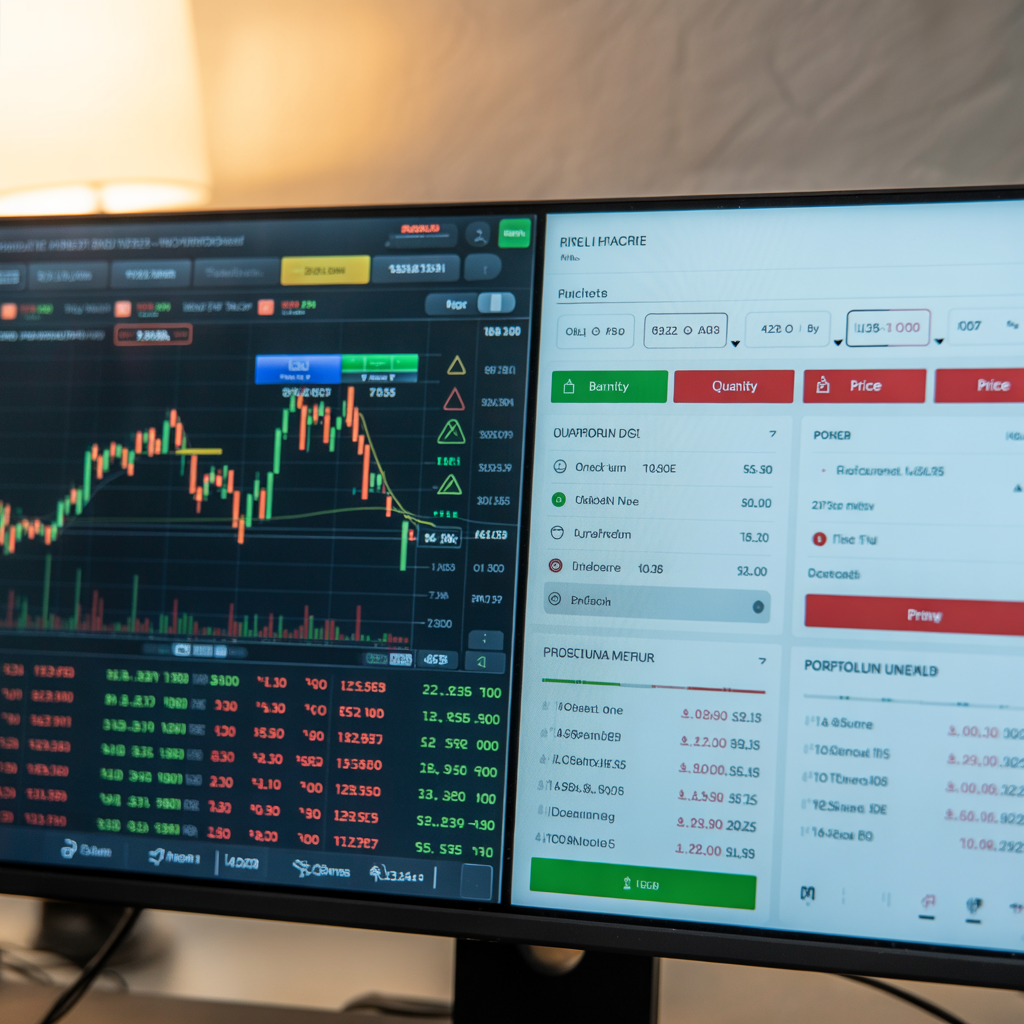
Your trading application has two modes available at the same time. On one side, an algorithm monitors the market, generates signals and executes trades automatically based on your rules. On the other side, a manual trading panel lets you place orders instantly with keyboard shortcuts or button clicks — without switching applications or logging into an exchange interface separately.
Both sides connect to the same exchange account. Positions opened by the algorithm are visible in your manual panel. A trade you open manually is visible to the algorithm. They share the same capital, the same position limits, and the same risk parameters.
Why this matters:
- You can intervene immediately if market conditions change in a way your algorithm was not designed for
- You can run the algorithm on some assets while trading others manually
- You gain confidence in the algorithm by watching it operate in real time alongside your own decisions
- You can take over manually during high-impact news events and let the algorithm resume afterward
This is fundamentally different from running an algorithm in a separate terminal while also logged into an exchange web interface. In that model, information is fragmented across tabs and applications, and execution is slow. In a proper hybrid setup, everything is unified: signals, positions, orders and manual controls all in one place.
The exchanges that support this kind of integrated setup well — with fast APIs, reliable WebSocket feeds and good order management — include Hyperliquid, Lighter and Apex. Dedicated guides for building algo and hybrid setups on each of these platforms are available in the pages linked below. For a practical guide to building the hybrid desktop interface itself — signals, manual controls and exchange APIs unified in a single application — see our Build Your Own Trading App article.
Common Strategies to Start With
If you are new to algo trading, these three strategies are the most accessible starting points — they are well understood, do not require microsecond execution, and have clear logic that is easy to implement and verify.
Moving Average Crossover (Trend Following) Buy when a short-term moving average crosses above a long-term moving average; sell when it crosses below. Simple, battle-tested, and a good first implementation project. Works best on higher timeframes (1H, 4H) where noise is lower.
Funding Rate Carry Go short on a perpetual futures contract while holding spot long. You are delta-neutral (market direction does not affect your PnL) and you earn the funding rate — the periodic payment from longs to shorts when the market is bullish. Requires continuous position management but is mechanically straightforward.
Mean Reversion on Spreads When the price of an asset diverges from its recent average by more than a defined threshold, take a position expecting it to return. Works well on range-bound markets and short timeframes. Requires tight risk management to avoid holding a losing position through a genuine trend break.
For a deeper treatment of these strategies — including backtesting approaches and institutional-scale variations — see our Advanced Algo Strategies page.
Key Takeaways
- Algo trading means automating your trading rules so a program executes them consistently, without emotion and without downtime
- Getting started requires an exchange API key, basic Python skills, market data access and a risk management layer
- You do not need to go fully automated from day one — a hybrid model combining algorithmic signals with manual control is a practical and powerful intermediate step
- The right exchanges for algo and hybrid trading provide fast, reliable APIs and good order management: Hyperliquid, Lighter and Apex are covered in dedicated guides
- Start simple, verify your logic carefully, and build complexity only after your basic setup is proven to work
Get Started on an Exchange
Each exchange below has a dedicated guide covering API setup, authentication, order placement, WebSocket streaming and code examples in Python.
pybit SDK with testnet.apexpro Python SDK.For institutional-grade strategy design, see our Advanced Algo Strategies page. For a technical deep-dive into crypto market microstructure, see our Algo Trading — Market Structure page.