Introduction
The professionals who have built successful crypto allocations did not start by buying every token in the top 100. They started with a clearly defined risk budget, a conservative allocation framework, and institutional-grade custody. They treated it like any other new asset class: research first, small initial position, learn while deployed.
This page outlines a practical, conservative approach designed for TradFi professionals who are ready to move from analysis to action. It is deliberately risk-conscious. The goal is a portfolio that is defensible to your investment committee, suitable for your existing risk framework, and structured to grow as your confidence and knowledge increases.
Step 1: Define Your Risk Budget Before Touching Any Asset
The single most important decision is not which assets to buy. It is how much of your total portfolio you are willing to allocate — and what drawdown level you can tolerate without being forced to sell.
A useful starting framework:
- 1–2% of AUM: Exploration allocation. Sized to be meaningful enough to learn from but small enough that a 70% drawdown (Bitcoin’s historical worst case) has limited total portfolio impact.
- 3–5% of AUM: Considered allocation. Appropriate for investors who have completed due diligence, established custody infrastructure and formed a multi-year investment thesis.
- 5–10% of AUM: Conviction allocation. Appropriate for investors with operational experience and an active risk management framework.
Most institutional first allocations sit in the 1–3% range. That is not timidity — it is appropriate position sizing for a new asset class in an early stage of institutional adoption.
Before allocating, answer three questions in writing: 1. What is the maximum drawdown I can absorb without being forced to liquidate? 2. What is my intended holding period — and under what conditions would I exit? 3. Who is responsible for ongoing risk monitoring and reporting?
Step 2: Choose Your Custody Structure
Custody is the most consequential operational decision you will make. The lesson of FTX — and of every exchange failure before it — is that assets held on an exchange are subject to counterparty risk. Institutional crypto custody means assets held in your name, at a regulated custodian, separated from the custodian’s own balance sheet.
Option A: Regulated Qualified Custodian (Recommended for most institutions)
The cleanest solution for most institutional investors. Your assets are held by a regulated entity under the same legal frameworks as traditional securities custody.
- Coinbase Custody Trust Company — NYDFS-regulated trust company, holds assets for most US spot Bitcoin ETFs
- Fidelity Digital Assets — SEC-registered, serves hedge funds, RIAs and family offices
- Anchorage Digital — the first OCC-chartered digital asset bank, offering banking-grade custody
- Copper — institutional custody with prime brokerage services, widely used by European hedge funds
- Fireblocks — technology infrastructure used by banks and custodians for secure digital asset transfer and storage
Option B: Regulated Exchange with Institutional Account
For investors who want execution and custody in a single relationship during an initial exploration phase.
- Coinbase Prime — institutional trading, custody and reporting in one platform
- Kraken Institutional — strong European regulatory standing, broad asset coverage
Option C: Spot ETF (Zero Custody Complexity)
For investors who want Bitcoin or Ethereum exposure with no digital asset custody requirements whatsoever.
- BlackRock iShares Bitcoin Trust (IBIT) — largest and most liquid spot Bitcoin ETF
- Fidelity Wise Origin Bitcoin Fund (FBTC) — strong institutional custody and operational track record
- iShares Ethereum Trust (ETHA) — spot Ethereum ETF, same custodial infrastructure
The ETF route is the lowest-friction starting point. The trade-off is that it does not give you access to stablecoin yield, DeFi protocols or on-chain settlement — which require actual digital asset custody.
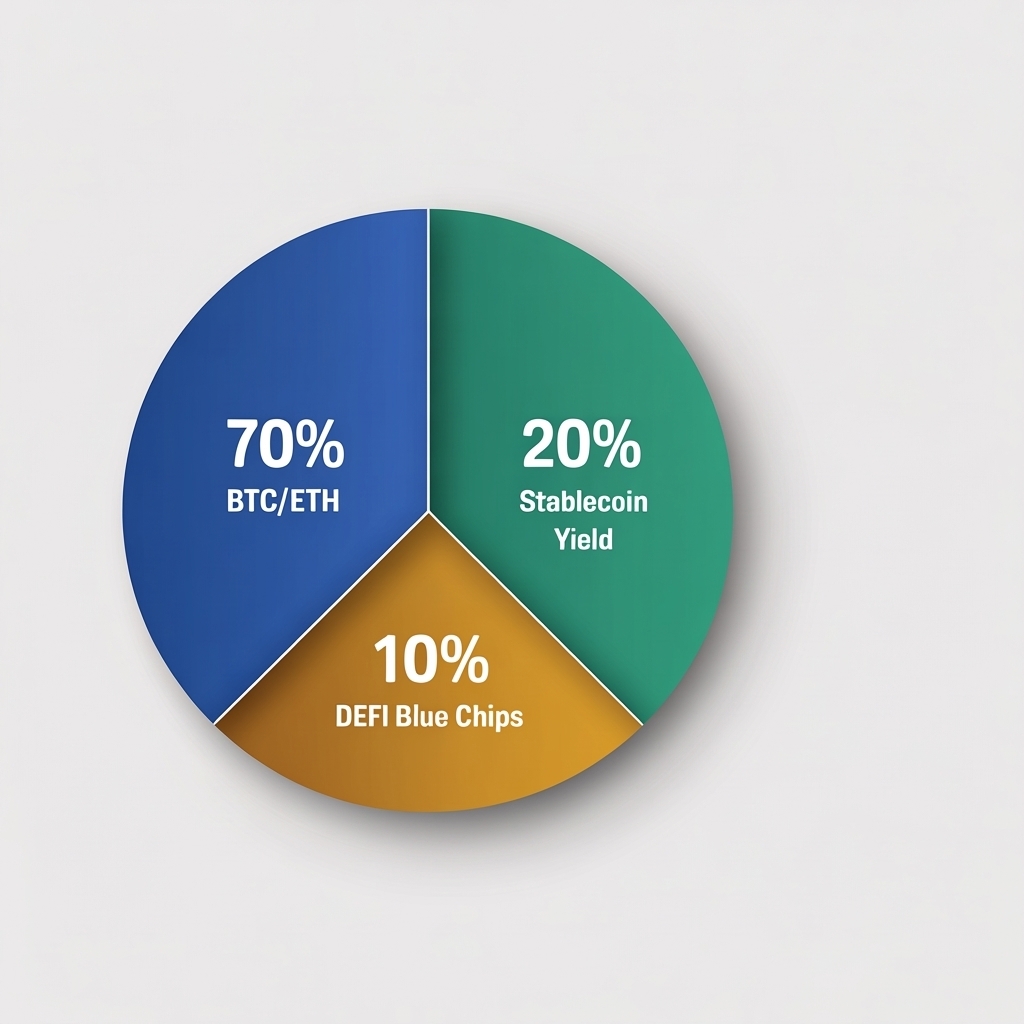
Step 3: The Three-Sleeve Allocation Framework
Once custody is established, the portfolio can be structured in three sleeves, each with a distinct risk/return profile.
Sleeve 1 — Core Directional Exposure: 70% of Crypto Allocation
Assets: Bitcoin (BTC) and Ethereum (ETH), in approximately equal weight or weighted toward Bitcoin for a more conservative stance.
Rationale: BTC and ETH are the two assets with the deepest liquidity, the longest track records, the most developed institutional infrastructure, and the clearest regulatory status. They represent the ”large cap” of the crypto universe — the assets where institutional size can be deployed without meaningful market impact.
Bitcoin is the primary store-of-value and scarcity narrative. Ethereum is the settlement infrastructure for much of on-chain finance, with a deflationary supply mechanism and yield-generating staking properties.
Implementation options: – Spot ETF (IBIT, FBTC, ETHA) — via existing brokerage infrastructure, no custody required – Direct spot purchase via Coinbase Prime or Fidelity Digital Assets — provides on-chain optionality – CME futures — regulated, familiar, suitable for hedging and tactical positioning
Sleeve 2 — Stablecoin Yield: 20% of Crypto Allocation
Assets: USDC or equivalent, deployed in yield-bearing structures
Rationale: This sleeve maintains dollar value while generating yield, typically in the 4–8% annualised range depending on market conditions. It provides a liquid reserve that can be redeployed into the core sleeve during drawdowns, and it introduces the team to on-chain operations without directional price risk.
Implementation options: – Circle Yield / Coinbase Prime yield accounts — off-chain, counterparty model, simplest operationally – Tokenised money market funds (BlackRock BUIDL, Franklin Templeton BENJI) — on-chain, backed by T-bills, daily yield accrual – AAVE on-chain lending — fully on-chain, yields driven by borrower demand, more operational complexity but transparent and auditable
Risk management: The yield in this sleeve should be evaluated against the risk of the structure generating it. T-bill-backed tokenised funds carry minimal credit risk. On-chain lending protocols carry smart contract and liquidity risk that must be assessed and sized accordingly.
Sleeve 3 — Blue-Chip DeFi Exposure: 10% of Crypto Allocation
Assets: Established DeFi protocol tokens and yield-generating positions
Rationale: This sleeve provides exposure to the growth of on-chain financial infrastructure — the protocols that generate real economic activity. It carries higher volatility than Sleeves 1 and 2, but represents participation in the revenue streams of DeFi networks rather than speculative token buying.
Selected examples: – AAVE (AAVE) — the largest decentralised lending protocol, with billions in active loans, fee revenue distributed to token stakers, and governance rights over the protocol – Maker/Sky (MKR/SKY) — the issuer of DAI, the largest decentralised stablecoin; revenue is generated from collateralisation fees and invested in T-bills via the Spark protocol – Uniswap (UNI) — the largest decentralised exchange, with fee revenue from billions in daily trading volume – Lido (LDO) — liquid staking infrastructure for Ethereum, managing over $20 billion in staked ETH
This sleeve is optional and should be omitted if the investment committee’s risk appetite does not extend to token-level exposure beyond Bitcoin and Ethereum.
| Sleeve | Allocation | Assets | Yield / Return Driver | Risk Level | Implementation |
|---|---|---|---|---|---|
| Core Directional | 70% | BTC 40%, ETH 30% | Price appreciation | Medium-High | Spot ETF or direct custody |
| Stablecoin Yield | 20% | USDC / tokenised MMF | 4–8% annualised | Low | Circle Yield, BUIDL, AAVE |
| Blue-Chip DeFi | 10% | AAVE, MKR, UNI, LDO | Protocol revenue + price | High | Direct custody + DeFi wallets |
Step 4: Risk Management Framework
A crypto allocation without an active risk framework is not an institutional allocation — it is a speculation. The following parameters should be defined before deployment:
Rebalancing triggers: Define thresholds at which you rebalance back to target weights. Bitcoin at 80% of crypto portfolio due to ETH underperformance is a different risk profile than the original allocation.
Drawdown limits: Define the portfolio-level drawdown at which you conduct a formal review — not necessarily a forced exit, but a structured assessment of whether the original thesis still holds.
Liquidity requirements: Ensure that a meaningful portion of the allocation (at minimum the stablecoin sleeve) is accessible within 24 hours to meet any liquidity requirements from the broader portfolio.
Reporting cadence: Monthly reporting on the crypto allocation to relevant oversight committees, using the same format and risk metrics (VaR, volatility, drawdown, correlation) as other asset classes.
Custody review: Annual review of custodian financial condition, regulatory standing and insurance coverage.
Step 5: Learning While Deployed
The most effective way to build institutional competence in crypto is to have skin in the game — at a size that is educational without being consequential.
Teams that have taken this approach consistently report the same finding: the operational and intellectual learning from managing an active allocation, even a small one, is substantially greater than any amount of desk research or conference attendance.
After six to twelve months with a conservative initial allocation, most institutional teams have a clearer and more confident view of how to size the position going forward — whether that means reducing it, maintaining it, or meaningfully expanding it.
Key Takeaways
- Define your risk budget and drawdown tolerance before selecting any assets
- Custody is the most consequential operational decision — regulated qualified custodians are the appropriate choice for institutional allocators
- A three-sleeve structure (70% BTC/ETH, 20% stablecoin yield, 10% blue-chip DeFi) provides a conservative, defensible framework
- Spot ETFs provide the lowest-friction entry point for investors who want price exposure without custody complexity
- Active risk management — rebalancing triggers, drawdown limits, regular reporting — is non-negotiable
Next: The institutional algorithmic strategies that have demonstrated durable edge in crypto markets — and how to evaluate their risk-adjusted return profiles.