Introduction
Hyperliquid is the most significant development in decentralised derivatives trading since the concept emerged. Built on its own purpose-built L1 blockchain, it delivers order book depth, execution speed, and fee levels that are competitive with the best centralised exchanges — without custodial risk, without KYC, and without the trust assumptions that come with depositing funds on a centralised platform.
By late 2024, Hyperliquid had become the dominant on-chain perpetuals venue by volume, regularly surpassing all other DEXes combined. The launch of the HYPE token in November 2024 — distributed entirely to users with no VC allocation — cemented its community standing and validated its model.
Affiliate disclosure: links to Hyperliquid on this page are affiliate links. We receive a commission if you open an account through them, at no cost to you. Our assessment is independent — see our affiliate policy.
The Technical Foundation
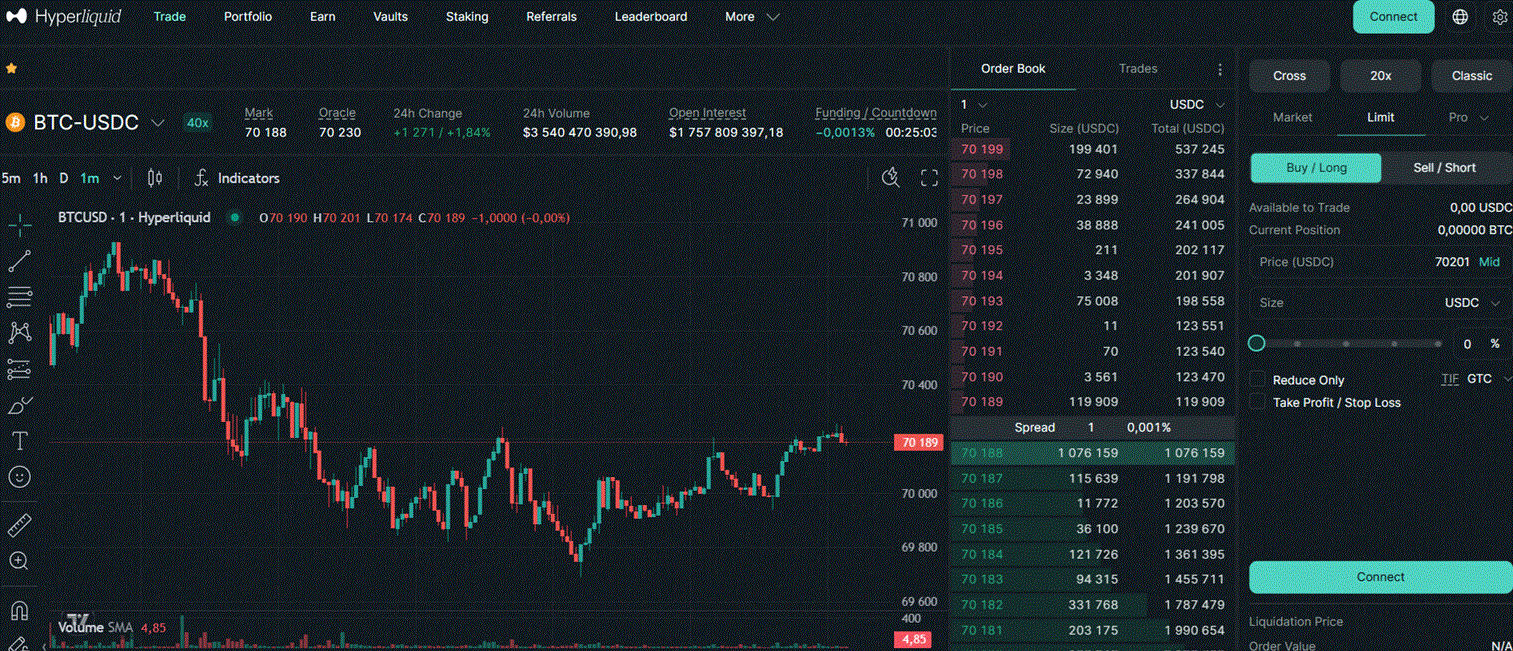
Most DEXes are built on top of existing general-purpose blockchains — Ethereum, Arbitrum, Solana. This creates a fundamental constraint: the underlying chain was not designed for high-frequency trading, and DEX performance is bounded by its host chain’s throughput and latency.
Hyperliquid built its own L1 from scratch, optimised specifically for order book trading. The result:
| Performance Metric | Hyperliquid | Typical General-Purpose DEX |
|---|---|---|
| Order latency | ~0.2 seconds | 2–15 seconds (block time dependent) |
| Throughput | 100,000+ orders/second | Limited by chain TPS |
| Order types | Limit, market, stop, TP/SL, reduce-only | Often market orders only or limited types |
| Order book | Full on-chain CLOB | AMM or partial order book |
The Central Limit Order Book (CLOB) model — the same model used by every professional exchange — runs entirely on-chain. Every order, fill, and cancellation is settled on the Hyperliquid L1. There is no off-chain matching engine with an on-chain settlement layer, as used by some hybrid DEXes. The entire system is verifiable.
What Hyperliquid Offers
| Product | Details |
|---|---|
| Perpetual Futures | 200+ markets, up to 50× leverage on BTC/ETH, cross and isolated margin |
| Spot Trading | Native spot market for HYPE and other assets listed on the L1 |
| Vaults | Deposit into strategy vaults run by top traders — on-chain copy trading |
| HLP Vault | Protocol-owned market maker vault — earn yield by providing liquidity to the exchange |
| API Trading | Full REST and WebSocket API — algorithmic and automated trading fully supported |
The Vaults feature deserves particular attention. Any trader can create a vault, make their strategy available to external depositors, and earn a performance fee on profits. Depositors get proportional returns from the vault’s trading. All vault activity is on-chain and fully transparent — you can inspect every trade the vault has made before depositing.
Fee Structure
| Market | Maker Fee | Taker Fee |
|---|---|---|
| Perpetuals (standard) | 0.00% (rebate at higher tiers) | 0.035% |
| Spot | 0.01% | 0.035% |
Hyperliquid’s fee structure is among the most competitive in the industry — taker fees of 0.035% match or beat most centralised exchanges at their standard tier. Maker fees are zero by default, with rebates available at higher volume tiers. There are no deposit or withdrawal fees beyond the standard bridge transaction cost.
Custody Model — Self-Custody Throughout
This is the fundamental differentiator from Bybit and any other centralised exchange. On Hyperliquid:
- You connect a wallet (MetaMask or any EVM-compatible wallet) — you never create an account with a username and password
- Funds are deposited via a bridge from Arbitrum — the deposit hits your on-chain account, controlled by your wallet key
- All trades are signed by your wallet — Hyperliquid cannot freeze, confiscate, or lose your funds
- Withdrawals are non-custodial — you withdraw to your wallet at any time, no approval required
The only custodial risk is the bridge smart contract — a meaningful but auditable risk that is standard across DeFi.
The HYPE Token
HYPE is the native token of the Hyperliquid L1. Its launch in November 2024 was notable for one reason above all others: no venture capital allocation. The entire supply was distributed to historical users of the platform based on their trading activity — no insiders, no VCs, no team allocation beyond a small future development fund.
This distribution model is unusual in crypto and was received extremely positively by the community. HYPE is used for staking on the L1 to secure the network and for fee discounts on the platform. Its market cap rapidly placed it among the top 20 crypto assets by value.
Who Should Use Hyperliquid
| Use Case | Recommendation |
|---|---|
| Active derivatives trader who wants non-custodial execution | Strong recommendation — best on-chain execution available |
| Trader outside the US wanting CEX-quality UX without KYC | Strong recommendation |
| Algorithmic / API trader | Strong recommendation — full-featured API with WebSocket support |
| Trader wanting to follow top strategies transparently | Suitable — Vaults provide on-chain copy trading with full auditability |
| User wanting to earn yield on stable capital | Suitable — HLP vault provides market-making yield |
| User completely new to DeFi / wallet management | Moderate — requires understanding of wallet setup and bridge mechanics |
Key Takeaways
- Hyperliquid is the dominant on-chain perpetuals exchange — built on a custom L1 that delivers execution speed and order book depth comparable to top CEXes
- Full self-custody throughout: funds are controlled by your wallet key at all times — no counterparty risk beyond the bridge smart contract
- Fee structure is among the most competitive in the market — 0.035% taker, zero maker at standard tier
- The Vaults system provides on-chain, fully transparent copy trading — every vault trade is visible before and after depositing
- HYPE token launched with no VC allocation — fully distributed to historical users, a genuinely unusual approach in crypto
- No KYC required — accessible globally without identity verification