Introduction
If you are looking for the lowest-friction entry point into digital assets, stablecoins are it. They carry no Bitcoin volatility. They do not require you to form a view on token prices. And they are already being used by corporate treasury departments, payment networks and banks you know by name.
A stablecoin is a digital token whose value is pegged to a traditional asset — almost always the US dollar. One USDC is always worth one dollar. One USDT is always worth one dollar. The blockchain is simply the settlement rail that moves them — faster, cheaper and more continuously than any wire transfer system built in the twentieth century.
This is not future technology. Stablecoins settled over $27 trillion in transaction volume in 2024 — exceeding the annual volume of Visa and Mastercard combined.
The Major Stablecoins: A Brief Guide
Not all stablecoins are the same. For institutional purposes, the differences in structure, backing and regulatory status matter.
USDC (USD Coin) Issued by Circle, regulated under US money transmission laws. Backed 1:1 by cash and short-duration US Treasuries, with monthly attestations by a Big Four accounting firm. USDC is the preferred stablecoin for institutional and corporate use due to its transparency and regulatory standing.
USDT (Tether) The largest stablecoin by market capitalisation and trading volume. Widely used across exchanges globally. Historically less transparent than USDC regarding reserve composition, though disclosure has improved. Dominant in emerging markets and high-volume trading contexts.
RLUSD (Ripple USD) Launched in late 2024, issued by Ripple and regulated by the New York Department of Financial Services (NYDFS). Designed specifically for cross-border payments and institutional settlement on the XRP Ledger and Ethereum.
PYUSD (PayPal USD) Issued by Paxos Trust Company on behalf of PayPal. Backed by US dollar deposits and short-term Treasuries. Targeted at PayPal’s existing merchant and consumer network — a sign of how mainstream stablecoin infrastructure has become.
| Stablecoin | Issuer | Regulatory Status | Backing | Primary Use Case | Daily Volume (approx.) |
|---|---|---|---|---|---|
| USDC | Circle | US money transmitter + EU MiCA | Cash + short-term Treasuries | Institutional, DeFi, corporate treasury | $10B+ |
| USDT | Tether | Licensed in El Salvador, BVI | Mixed (cash, T-bills, other) | Trading, emerging markets, exchanges | $50B+ |
| RLUSD | Ripple | NYDFS regulated | USD deposits + Treasuries | Cross-border payments, settlement | Growing |
| PYUSD | Paxos / PayPal | NYDFS regulated | USD deposits + Treasuries | Consumer payments, merchant settlement | Growing |
Source: Company disclosures, CoinGecko, The Block.
Why Corporate Treasury Departments Are Paying Attention
The traditional cross-border payment process is one of the more antiquated workflows still operating in global finance. A wire transfer between a corporate account in Stockholm and a counterparty in Singapore typically involves correspondent banking, takes 1–3 business days, costs 0.5–2% in fees and charges, and is completely opaque until the money arrives.
The stablecoin alternative: transfer USDC from a Circle Business Account or Coinbase Prime account to any compliant destination globally, settlement in under two minutes, fees measured in cents, 24 hours a day, 365 days a year, with full on-chain traceability.
Companies including Stripe (which acquired Bridge, a stablecoin infrastructure company, in 2024 for $1.1 billion), Shopify, and a growing list of multinationals have integrated stablecoin rails into their treasury and payment operations. This is not experimentation — it is operational treasury management.
A Practical Example: Moving Capital from a Bank to an Institutional Crypto Account
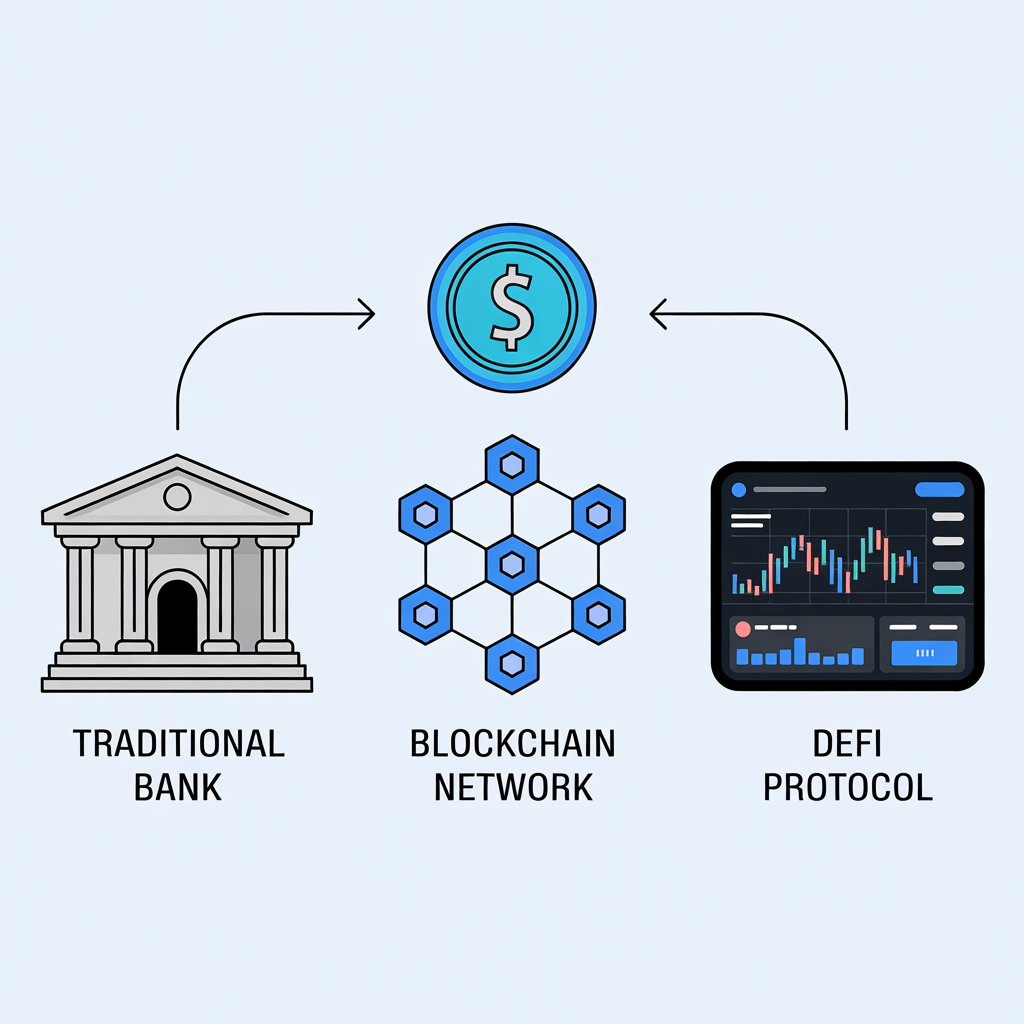
Here is a concrete walkthrough of how a treasury team or portfolio manager might move $100,000 from a traditional bank account to a position on Coinbase Prime — using stablecoins as the bridge.
Step 1 — Fund your Circle Business Account or Coinbase Prime account Wire $100,000 USD from your bank account to your verified institutional account. This step uses traditional wire infrastructure. One-time KYC/AML onboarding is required. Time: Same day or next day, depending on your bank’s wire cut-off
Step 2 — Convert to USDC Your dollars are converted 1:1 to USDC. No price risk. No fees beyond a small conversion spread (typically 0–5 bps at institutional scale). Time: Instant
Step 3 — Deploy your capital From here, your options open up: – Hold USDC in a yield-bearing account (Circle Yield, Coinbase Prime, or on-chain via AAVE) earning rates comparable to money market funds – Convert to Bitcoin, Ethereum or other assets for directional exposure – Transfer on-chain to participate in tokenised Treasury products or DeFi protocols
Time: Minutes
Step 4 — Return to fiat (when needed) Reverse the process: convert to USDC, redeem to your bank account via wire. Settlement typically within one business day.
The entire round-trip is faster, cheaper and more transparent than most internal treasury processes — and fully auditable on-chain.
Banks Are Already Here
It is worth being specific: this is not a technology that banks are watching from a distance. It is one they are actively deploying.
- JPMorgan’s Onyx platform processes billions in intraday repo transactions using JPM Coin, a permissioned stablecoin for institutional clients
- Société Générale’s Forge division has issued tokenised covered bonds and uses stablecoins for on-chain settlement
- Swift completed a series of trials in 2024–2025 using stablecoins for cross-border interoperability between traditional banking networks
- Citi’s Treasury and Trade Solutions division offers stablecoin-based instant cross-border payment services to multinational clients
The question is no longer whether stablecoins are a legitimate institutional instrument. The question is which stablecoins, on which infrastructure, with which custodians — and those are answerable questions with clear frameworks.
The Risk Landscape
Stablecoins are not risk-free, and it would be misleading to suggest otherwise. The relevant risks for institutional users are:
Reserve risk: The value of a stablecoin depends on the quality and liquidity of its reserves. USDC’s transparent, Treasury-backed reserves carry minimal risk. Less transparent issuers carry more.
Smart contract risk: On-chain stablecoin transfers involve smart contracts, which can have vulnerabilities. Using established, audited protocols and regulated custodians significantly mitigates this.
Regulatory risk: The legal status of stablecoins continues to evolve. The US Stablecoin Act (passed in principle in 2025) and MiCA in the EU provide increasing regulatory clarity, but the framework is not yet complete everywhere.
These risks are manageable with the same diligence applied to any new instrument or counterparty — which is exactly the work that institutional teams are equipped to do.
Key Takeaways
- Stablecoins are dollar-denominated digital tokens that settle globally in minutes at near-zero cost
- USDC and RLUSD offer regulated, transparent structures suitable for institutional use
- Corporate treasury use cases are live and operational at major multinationals today
- Banks including JPMorgan, Citi and Société Générale operate active stablecoin infrastructure
- Risks are real but manageable — reserve quality, smart contract exposure and regulatory developments are the primary considerations
Next: How algorithmic trading in crypto compares to the quant and systematic strategies you already know — and where the real structural differences lie.