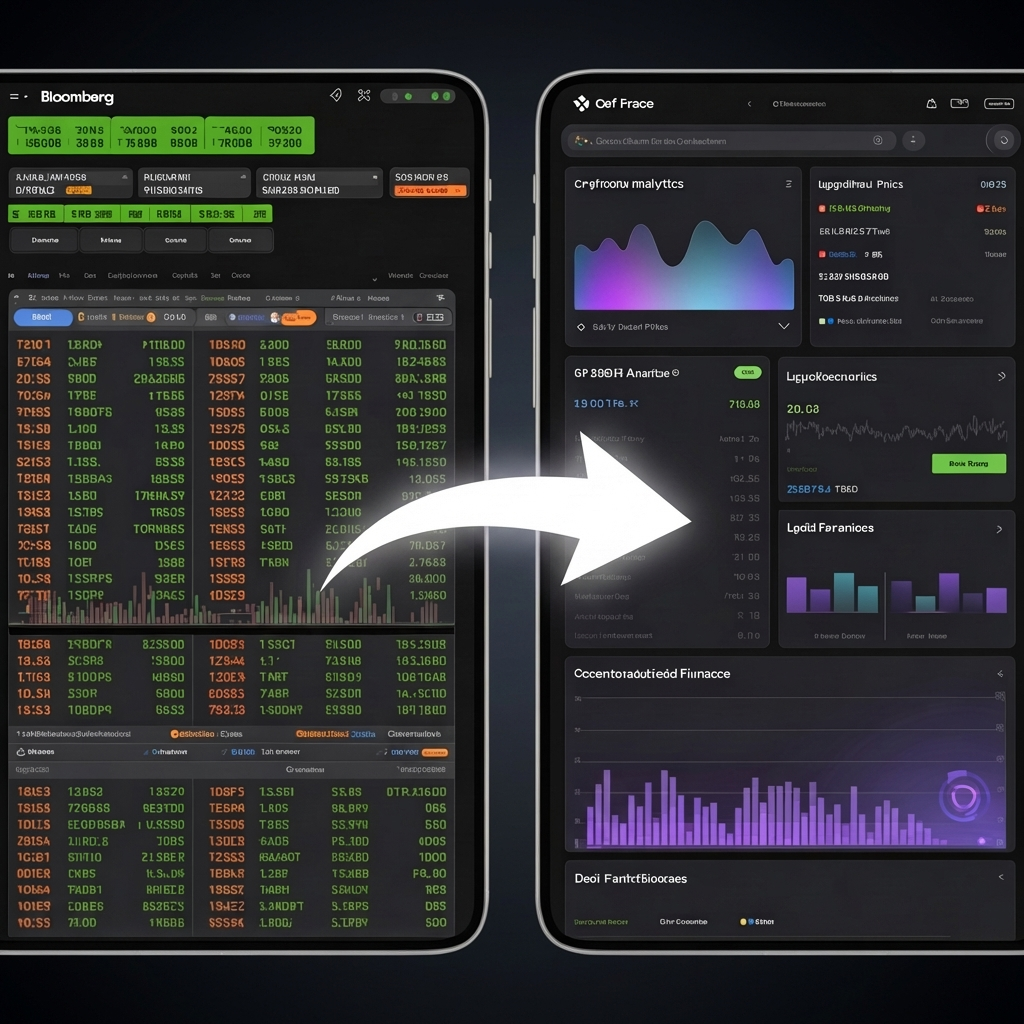
One of the most underappreciated barriers between traditional finance and crypto is vocabulary. The concepts are often familiar — the terminology is not. A DeFi whitepaper reads like a foreign language to a credit analyst not because the underlying ideas are alien, but because the same ideas have been given entirely new names.
This glossary works in both directions. If you are a TradFi professional learning crypto, the left column is your starting point. If you are already operating in crypto and need to explain your work to a risk committee or compliance department, the right column gives you the translation they will understand.
The list is curated for institutional relevance — these are the terms you will encounter in professional contexts, due diligence processes and client conversations.
The language of crypto and the language of TradFi describe many of the same concepts — this guide bridges the gap for institutional practitioners.
Section A: Market Infrastructure
TradFi Term
TradFi Definition
Crypto Equivalent
Notes
Stock Exchange
Centralised venue matching buy and sell orders for securities
Centralised Exchange (CEX)
Binance, Coinbase, Kraken, OKX. Same function, no regulatory equivalent of RegNMS
Dark Pool
Private trading venue for institutional block trades
OTC Desk / RFQ
Wintermute, B2C2, Cumberland — provide off-exchange liquidity for large orders
Financial services running on public blockchains via smart contracts
Shadow Banking / FinTech
Imperfect analogy — DeFi is more transparent and permissionless than shadow banking
Smart Contract
Self-executing code on a blockchain that enforces agreement terms
ISDA Master Agreement / CSA
Smart contracts automate what ISDA agreements describe in legal text
Liquidity Pool
Pool of assets deposited by users to enable DEX trading
Market Maker Inventory
Passive equivalent of a market maker’s inventory. Earns fees from trades
Yield Farming
Deploying capital across DeFi protocols to maximise returns
Cash and Carry / Multi-Leg Carry Trade
Combines lending, liquidity provision and incentive farming
Staking
Locking tokens to support network security in return for yield
Dividends / Coupon
Ethereum staking yield: ~3–4% annually. Comparable to a bond coupon with operational requirements
Gas Fee
Fee paid to process a transaction on a blockchain
Transaction Cost / Exchange Fee
Variable, can spike significantly during congested periods
Wallet
Software or hardware holding private keys to access crypto assets
Brokerage Account
Critical difference: losing private keys means permanent loss of assets
Private Key
Cryptographic key providing sole control over assets
Account Password + Legal Identity
No recovery mechanism. Institutional custody uses multi-signature and HSM technology
Multi-Sig (Multi-Signature)
Requires multiple approvals before a transaction executes
Dual Control / Four-Eyes Principle
Standard institutional practice. Fireblocks and similar platforms implement this
TVL (Total Value Locked)
Total assets deposited in a DeFi protocol
AUM (Assets Under Management)
Primary metric for DeFi protocol size and adoption
Slippage
Difference between expected and actual execution price
Market Impact / Slippage
Same concept. Higher in less liquid assets and DEX trading
Rug Pull
Protocol developers abscond with deposited funds
Fraud / Ponzi Scheme
Risk concentrated in unaudited, anonymous protocols. Not a risk in established protocols
Fork
Change to a blockchain’s code, potentially creating a new chain
Corporate Action / Spin-off
Hard forks (Bitcoin / Bitcoin Cash in 2017) create new assets. Managed by custodians
On-Chain
Activity recorded directly on a blockchain
On-Balance Sheet
Fully transparent and auditable — anyone can verify
Off-Chain
Activity occurring outside a blockchain
Off-Balance Sheet
Less transparent. CEX trading is off-chain until withdrawal
Section F: Regulatory and Legal
TradFi Term
Crypto Equivalent
Notes
SEC Registration
MiCA Licence / VASP Registration
Jurisdiction-dependent. EU MiCA provides the most comprehensive framework
ISDA Agreement
Smart Contract (on-chain) / Exchange ToS (off-chain)
Smart contracts enforce terms algorithmically. No legal system required for execution
Basel III Capital Requirements
No direct equivalent yet
FSB and BIS are developing crypto capital treatment for banks
MiFID II
MiCA (EU)
MiCA covers crypto asset issuance, exchange operation and stablecoin issuance
Dodd-Frank
No direct equivalent
US regulatory framework for crypto remains fragmented across SEC, CFTC, OCC
FATF / AML Rules
Travel Rule (blockchain)
Chainalysis and Elliptic provide blockchain analytics for compliance with Travel Rule requirements
Key Takeaways
Most crypto concepts have direct TradFi analogues — the vocabulary is new, not the underlying finance
The most important translations for institutional practitioners: custody, prime brokerage, risk management and regulatory frameworks
DeFi-specific terms (impermanent loss, gas, TVL) describe genuinely new mechanisms without TradFi equivalents
Smart contracts are the operational equivalent of ISDA agreements — enforced by code rather than legal systems
On-chain transparency means that audit and verification in DeFi is often simpler than in traditional finance — if you know where to look
Next: The future of investment banking careers in a world reshaped by crypto — new roles, new skills, and why the professionals who adapt earliest are positioned best.