Introduction
Altcoin season is the phase of the crypto market cycle when a broad range of altcoins dramatically outperform Bitcoin. For a period that can last weeks to months, tokens that lagged during the Bitcoin-led rally accelerate, often posting 200–500% gains while Bitcoin consolidates. It is the highest-return phase of the cycle for active investors — and the most dangerous phase for those who arrive late.
The difficulty is that altcoin season does not announce itself. By the time it is obvious to everyone that altcoins are running, much of the move has already happened. The investors who capture the bulk of the gains are those who identified the preconditions in advance and positioned before the rotation became crowded.
This article covers the leading indicators that precede altcoin season, how to distinguish a genuine rotation from a false start, which categories of altcoins tend to lead and which tend to lag, and how to position and exit without overstaying.
What Causes Altcoin Season
Understanding the mechanism behind altcoin season helps identify when it is beginning — not just when it has already started.
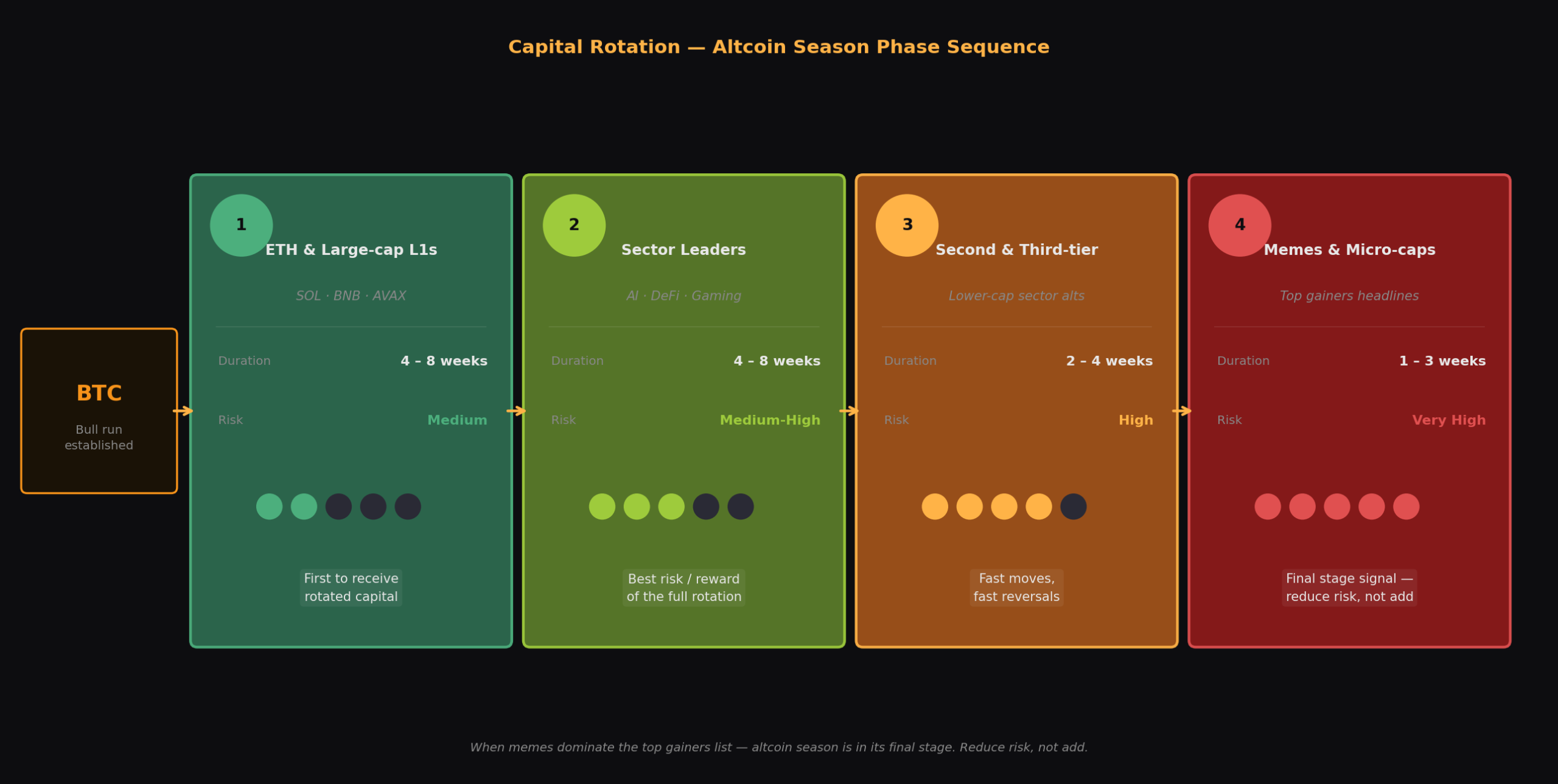
Altcoin season is driven by a capital rotation dynamic: Bitcoin rises strongly, Bitcoin holders accumulate large unrealised profits, and at some point those profits are rotated into higher-risk assets in search of greater returns. The rotation follows a rough sequence:
- Bitcoin leads the market higher — dominance rises, altcoins lag
- Bitcoin price consolidates or slows — holders begin taking partial profits
- Profits rotate into large-cap altcoins first (ETH, SOL, major L1s)
- Large-cap gains attract attention — capital flows further out the risk curve into mid-cap sector leaders
- Mid-cap gains create a FOMO effect — capital floods into small-caps, memes, and narrative tokens
- The rotation reverses — often rapidly — as Bitcoin dominance reasserts and altcoin liquidity dries up
This sequence is not deterministic — it can skip steps, stall, or reverse before reaching the later stages. But recognising which step is underway helps determine where in the cycle you are and how much time the rotation has left.
Leading Indicators — What to Watch Before It Starts
1. BTC Dominance — the Primary Signal
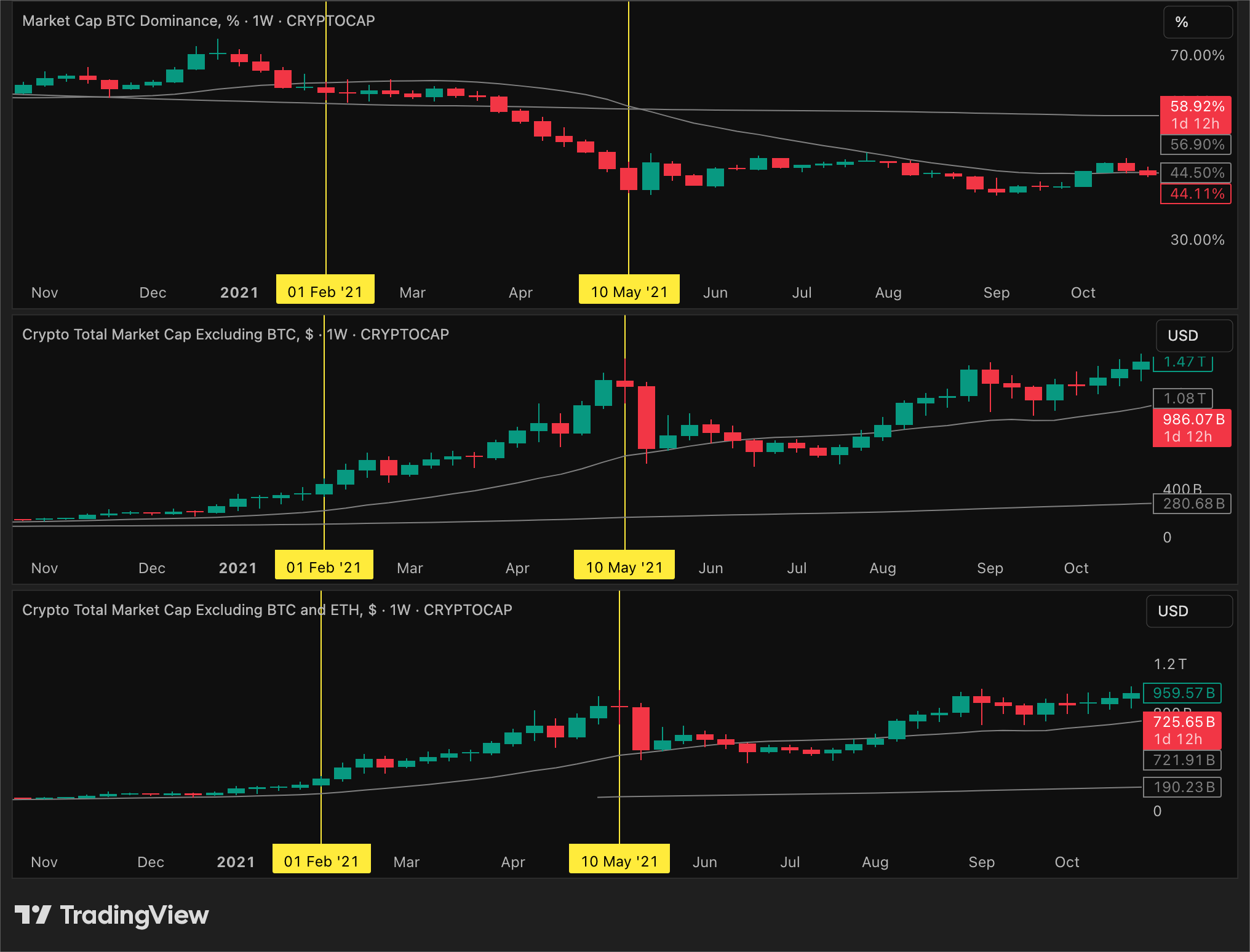
The most important indicator for altcoin season is BTC dominance. A sustained fall in dominance — not a single-day dip, but a multi-week downtrend — is the clearest signal that capital is rotating out of Bitcoin and into the broader market.
Key levels to watch on the BTC dominance chart (TradingView: BTC.D): – A break below a recent dominance floor, held for more than a week, confirms the rotation is underway – The speed of the dominance fall matters: a gradual decline signals orderly rotation; a sharp collapse signals panic and FOMO, which often precedes a violent reversal
The companion signal is the ETHBTC pair. Ethereum typically leads the altcoin rotation — a sustained break upward in ETHBTC, combined with falling BTC dominance, has historically been one of the earliest and most reliable signals that a genuine altcoin season is beginning.
2. Total2 and Total3 Outperforming
On TradingView, compare Total market cap (all crypto), Total2 (all crypto excluding Bitcoin) and Total3 (all crypto excluding Bitcoin and Ethereum):
- Total2 outperforming Total: ETH and large-cap alts are leading — early stage rotation
- Total3 outperforming Total2: mid and small-caps are leading — mid-stage rotation, higher risk/reward but more volatile
- Total3 moving faster than Total2 by a significant margin: late-stage FOMO — the rotation has reached the furthest end of the risk curve
3. On-Chain: LTH Distribution and Exchange Inflows
On Glassnode, a sustained decline in Long-Term Holder supply — combined with Bitcoin exchange inflows — signals that experienced holders are taking profits. This profit-taking is the source of the capital that fuels altcoin season. Without LTH distribution, the rotation lacks fuel.
4. Funding Rates — Altcoin Funding Turning Positive
When altcoin perpetuals begin showing positive funding rates while Bitcoin funding is moderate or neutral, it signals that leveraged longs are building in altcoins ahead of or during the rotation. Check CoinGlass for funding across ETH, SOL, and the major sector tokens.
| Indicator | Early Signal | Confirmation |
|---|---|---|
| BTC Dominance | Starts declining from multi-month high | Multi-week downtrend below key support level |
| ETHBTC | Bottoms and begins reversing | Sustained break above recent resistance |
| Total2 vs Total | Total2 begins outperforming | Consistent outperformance over 2–4 weeks |
| Total3 vs Total2 | Begins narrowing | Total3 clearly outperforming Total2 |
| LTH Supply (Glassnode) | Starts declining from peak | Sustained multi-week decline |
| Altcoin funding rates | Turn mildly positive from neutral | Persistently positive across major altcoins |
False Starts — How to Tell the Difference
Not every altcoin rally is the beginning of altcoin season. False starts are common — a week or two of altcoin outperformance followed by a sharp reversal back to Bitcoin dominance. Several conditions distinguish a genuine rotation from a false start:
Duration: a single week of altcoin outperformance is noise. Two to three weeks of consistent Total2 and Total3 outperformance, with BTC dominance making lower highs, is a trend.
Breadth: genuine altcoin season is broad — hundreds of tokens are moving, across multiple sectors. A false start is narrow — three or four tokens in one sector spike while the rest of the market is quiet.
Bitcoin behaviour: in genuine altcoin season, Bitcoin is consolidating or moving slowly upward — not crashing. If altcoins are rallying while Bitcoin is falling, it is not a rotation; it is a risk-on spike in a stressed market, which reverses when Bitcoin stabilises.
Volume: genuine sector rotation is accompanied by rising spot volume on altcoin markets across multiple exchanges. A false start often shows volume concentrated on a single exchange or in a single token.
Which Categories Lead and Which Lag
Altcoin season does not lift all boats equally. Categories rotate in a rough order of liquidity — the most liquid assets move first, the least liquid last.
| Phase | Leading Category | Characteristics |
|---|---|---|
| Phase 1 | Ethereum and large-cap L1s (SOL, BNB, AVAX) | Highest liquidity, first to receive rotated capital — move earliest and most reliably |
| Phase 2 | Sector leaders in narrative themes (AI, DeFi, gaming) | Mid-cap tokens with clear narratives and genuine user bases — strong risk/reward in this phase |
| Phase 3 | Second and third-tier sector tokens | Lower liquidity, higher volatility — fast moves but also fast reversals |
| Phase 4 | Meme coins and micro-caps | Last to move, most parabolic, shortest duration — the signal that the rotation is in its final stage |
A practical rule: when meme coins are dominating the top gainers list and being featured in mainstream crypto media, altcoin season is in its final stages. This is the moment to be reducing risk, not adding it.
Positioning — How to Build Exposure
Before altcoin season starts
The best time to build altcoin exposure is during the late accumulation phase — when BTC dominance is high, altcoins are quiet, and the leading indicators are beginning to shift but the rotation has not yet become obvious.
In this phase, focus on quality: large-cap altcoins with genuine usage, reasonable valuations relative to comparable projects, and no major unlock events in the next 3–6 months. These are the assets most likely to lead when rotation begins and most likely to recover if the rotation is a false start.
Position sizing should be modest — this is anticipatory positioning, not conviction positioning. Size up when the leading indicators confirm.
During altcoin season
Once the rotation is confirmed (multi-week BTC dominance downtrend, Total2 outperforming, ETHBTC breaking higher), increase position sizes in the leading categories (Phase 1 and Phase 2) and begin researching Phase 3 candidates.
Use CoinGlass to monitor altcoin funding rates. When funding on major altcoins exceeds 0.05%/8h persistently, the leveraged long position is becoming crowded — consider trimming.
Exit strategy — do not overstay
The single most common mistake in altcoin season is holding too long. The rotation reverses faster than it built. Signs that it is ending:
- Meme coins are dominating the top gainers (Phase 4 signal)
- BTC dominance stops falling and begins to stabilise or reverse
- Total3 starts underperforming Total2 — small-caps roll over before large-caps
- Altcoin funding rates spike above 0.1%/8h across the board — extreme leverage
- Bitcoin price begins falling — the whole risk-on dynamic collapses
When three or more of these signals appear simultaneously, the rotation is in its final days. Begin reducing positions in the most illiquid holdings first — small-caps and memes — and progressively move back toward Bitcoin or stablecoins.
A Practical Altcoin Season Checklist
Before entering (accumulation phase): – [ ] BTC dominance near multi-month high or showing early signs of decline – [ ] ETHBTC showing signs of bottoming – [ ] Macro cycle position: MVRV in the 2–5 range (mid cycle) – [ ] No major altcoin unlock events in next 3 months
Rotation confirmed — increase exposure: – [ ] BTC dominance in multi-week downtrend – [ ] ETHBTC breaking above resistance – [ ] Total2 consistently outperforming Total – [ ] LTH supply declining (Bitcoin profit-taking underway)
Late stage — begin reducing: – [ ] Meme coins in top daily gainers regularly – [ ] Altcoin funding above 0.05%/8h persistently – [ ] BTC dominance stabilising or reversing – [ ] Total3 rolling over relative to Total2
Key Takeaways
- Altcoin season is driven by capital rotation from Bitcoin profits into progressively riskier assets — understanding the mechanism helps identify when it is beginning, not just when it is obvious
- The leading indicators — BTC dominance decline, ETHBTC reversal, Total2 outperformance, LTH distribution — appear weeks before the rotation becomes visible to the broader market
- Distinguish genuine rotations from false starts by checking breadth, duration, Bitcoin’s behaviour, and volume across exchanges
- The rotation follows a consistent phase sequence: ETH and large-cap L1s → sector leaders → second-tier alts → meme coins — each phase has different risk/reward
- When meme coins dominate the top gainers list, the rotation is in its final stage — this is the moment to reduce risk, not add it
- Exit strategy is as important as entry: reduce the most illiquid positions first, and watch for three or more late-stage signals appearing simultaneously