Every experienced trader knows the feeling: a setup looks right on the chart, but something is off. The trend is there, but funding is elevated. OI is growing, but price is not following. You take the trade anyway — and get stopped out in a crowded unwind.
The Confluence Score is designed to solve exactly that problem. It combines five independent market structure signals into a single score — so you know before you trade whether the evidence is aligned or conflicted.
What the Score Measures
The Confluence Score runs from −5 to +5. Each of five factors contributes +1 or −1:
| Factor | Long signal (+1) | Short signal (−1) |
|---|---|---|
| Trend 4H | Bullish (price > MA20 > MA200) | Bearish |
| Trend Daily | Bullish | Bearish |
| Funding h4 | Negative — shorts are paying | Positive — longs are paying |
| OI Δ4H | Growing ≥ +2% — new positions opening | Unwinding ≤ −2% |
| OI / Price divergence | OI falling, price rising — squeeze setup | OI rising, price falling — weak longs |
A score of +3 means three independent factors point long. A score of −4 means the market is positioned heavily short with trend confirmation. Neutral factors score zero — they neither add nor subtract.
The labels map cleanly to conviction levels:
| Score | Label |
|---|---|
| +4 / +5 | Strong Long Setup |
| +2 / +3 | Long Setup |
| +1 | Mild Long Bias |
| 0 | Neutral |
| −1 | Mild Short Bias |
| −2 / −3 | Short Setup |
| −4 / −5 | Strong Short Setup |
The Three-Step Framework
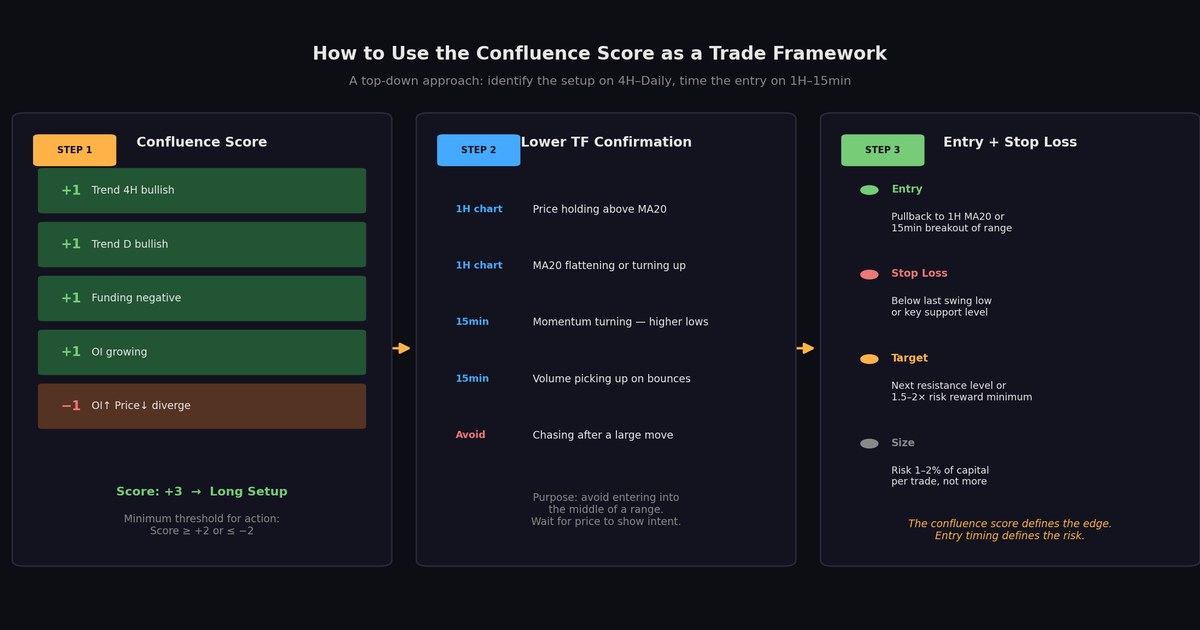
Step 1 — Check the Confluence Score
Open the live signals page and look at the Confluence Score table at the top. It is sorted by score, highest first.
Only act on scores of +2 or higher for longs, −2 or lower for shorts. A score of +1 or −1 means the evidence is thin — one factor pointing one way, the rest flat or conflicting. That is not a trade, that is noise.
A score of +3 or +4 means trend, funding positioning and OI are all pointing the same direction. That is a meaningful edge. Not a guarantee — but a genuine asymmetry.
Also read the breakdown column. Two factors of the same type (e.g., both trend factors bullish but funding neutral) is weaker than three independent factors aligned. The more independent the signals, the more robust the setup.
Step 2 — Confirm on a Lower Timeframe
The Confluence Score tells you what the market structure looks like on 4H and Daily. It does not tell you when to enter.
Once you have a score ≥ +2, drop to the 1H chart:
- Is price holding above the 1H MA20?
- Is the MA20 flattening or beginning to slope upward?
- Are higher lows forming on the 15-minute chart?
- Is volume increasing on bounces and decreasing on pullbacks?
If yes — the lower timeframe is beginning to confirm what the higher timeframe already shows. That is the window to start looking for an entry.
If the 1H is still in a downtrend or choppy — wait. The confluence score does not expire quickly. A score of +3 that holds for several hours is stronger than one that appeared and disappeared. Patience is part of the edge.
Step 3 — Entry, Stop Loss and Size
Entry: Pullback to the 1H MA20 or a 15-minute breakout of a consolidation range. Avoid chasing after a large move has already occurred — you are entering late and your stop will need to be wider.
Stop loss: Below the last swing low or a key support level. Not arbitrary, not a fixed percentage — structural. The market tells you where it is wrong.
Target: Next resistance level, or a minimum of 1.5–2× your risk. If you are risking $500, your target should be at least $750–$1,000. Without asymmetry, even a 60% win rate does not save a portfolio.
Size: Risk 1–2% of capital per trade. The confluence score improves your win rate, but no model is right every time. Sizing correctly means a losing trade is an inconvenience, not a problem.
What the Score Does Not Replace
The Confluence Score is a structured starting point. It does not replace:
- Reading the chart. Support and resistance levels, chart patterns, volume context — these are layers the score does not capture.
- Macro awareness. A high-impact event (FOMC, CPI, major protocol news) can override any technical setup.
- Your own risk tolerance. A score of +4 does not mean you should bet large. It means the setup is well-aligned. Position sizing is always your call.
Think of the score the way a TradFi analyst thinks about a multi-factor model: it improves the base rate, it does not remove the uncertainty. The value is in filtering out the low-conviction setups — the trades you would have taken on impulse and regretted.
A Live Example
When SOL recently showed Mild Long Bias (+1) — negative funding, growing OI, but bearish on the Daily — the breakdown made the logic visible: one factor for, one against, one neutral. Not a trade. An observation worth watching.
When the Daily trend flips bullish and the score moves to +3, the setup changes character entirely. Same asset, same funding, same OI — but now three factors aligned. That is when you start watching the 1H for entry.
The difference between a +1 and a +3 is not twice the confidence. It is the difference between watching and acting.
View the live Confluence Score →
All data is sourced live from the Hyperliquid API — the on-chain perpetuals exchange where these signals are most directly actionable.