Introduction
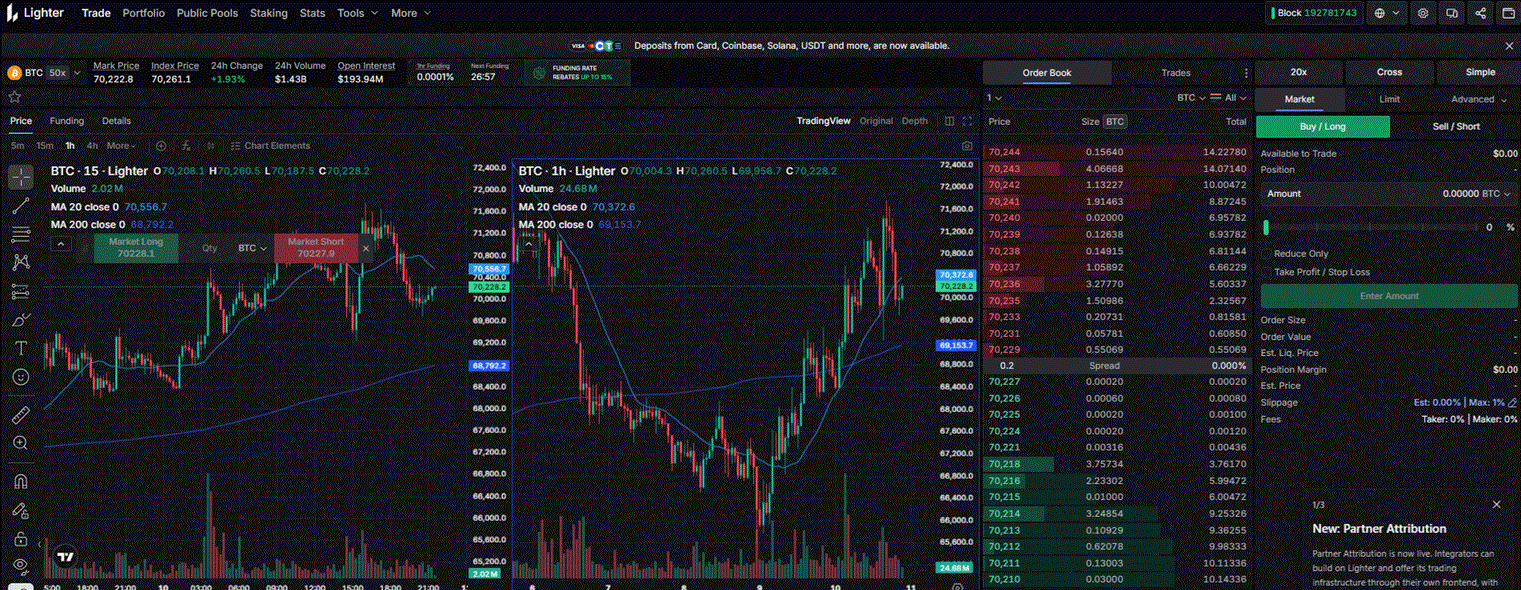
Lighter is a decentralised exchange built on a purpose-built ZK-rollup chain, designed from the ground up for professional-grade order book trading. Where most DEXes compromise on execution quality to achieve decentralisation, Lighter’s architecture is built around the premise that you should not have to choose between self-custody and institutional-quality execution.
Still in growth phase and smaller than Hyperliquid by volume, Lighter is the choice for traders who want early exposure to a technically differentiated platform — and who value the referral programme and community incentives that accompany early adoption of a high-conviction project.
Affiliate disclosure: links to Lighter on this page are affiliate links. We receive a commission if you open an account through them, at no cost to you. Our assessment is independent — see our affiliate policy.
The ZK Architecture
Lighter’s technical foundation differs from Hyperliquid in a meaningful way. While Hyperliquid runs on a custom L1 with a validator set, Lighter is built on a ZK-rollup — a cryptographic architecture where every state transition is provably correct by mathematical proof rather than validator consensus.
What this means in practice:
- Every trade and settlement is accompanied by a zero-knowledge proof that can be verified against Ethereum’s base layer
- The security assumption ultimately rests on Ethereum’s settlement layer — the most battle-tested security in crypto
- No trust in a validator set is required — the ZK proof either validates or it does not
- Execution happens off the base layer for speed and cost, but settlement is cryptographically anchored to Ethereum
For users with a background in cryptography or financial infrastructure, the ZK model is a meaningfully different trust assumption from a standalone L1. For most traders, the practical implication is: fast execution, low fees, and a security model that ultimately inherits from Ethereum.
What Lighter Offers
| Product | Details |
|---|---|
| Perpetual Futures | Major pairs including BTC, ETH, SOL and growing asset list, cross and isolated margin |
| Spot Trading | Spot markets for supported assets |
| Full Order Book | Central Limit Order Book — limit, market, stop, TP/SL order types |
| API Access | REST and WebSocket API for algorithmic trading |
| Referral Programme | Share your referral link and earn a percentage of referred traders’ fees |
Fee Structure
Lighter operates with highly competitive fees designed to attract volume from both retail and algorithmic traders:
| Market | Maker Fee | Taker Fee |
|---|---|---|
| Perpetuals | 0.00% | 0.03% |
| Spot | 0.00% | 0.03% |
Zero maker fees and 0.03% taker fees place Lighter among the most cost-efficient on-chain trading venues. For high-frequency or algorithmic traders whose edge is sensitive to execution cost, this matters significantly.
Custody Model
Like Hyperliquid, Lighter is fully non-custodial. Connect your EVM-compatible wallet, deposit, and trade — your funds are controlled by your private key throughout. Lighter cannot freeze accounts, confiscate funds, or require approval for withdrawals.
The ZK architecture adds an additional layer: because every state transition is proven on-chain, the exchange cannot misrepresent your balance or execute trades that are not authorised by your wallet signature. This is a stronger guarantee than a validator-based L1 where you are trusting the validator set to behave correctly.
The Referral Programme
Lighter runs an active referral programme — create a referral link and earn a percentage of the trading fees generated by traders you refer, for as long as they trade on the platform. This is a meaningful passive income stream for content creators, analysts, and community builders who can direct qualified traffic to the platform.
Our referral link: https://app.lighter.xyz/?referral=TRADFIDEFI
Early Stage Considerations
Lighter is a younger platform than Hyperliquid or Bybit. This comes with specific tradeoffs that traders should weigh:
| Consideration | Details |
|---|---|
| Liquidity depth | Lower than Hyperliquid and CEXes on most pairs — suitable for standard position sizes, less so for very large orders |
| Asset coverage | Growing but currently more limited than mature platforms — major pairs well-covered |
| Smart contract risk | Newer contracts carry higher inherent risk than battle-tested protocols — audit status should be verified before significant deposits |
| Upside | Early users of platforms that succeed have historically benefited from airdrop programmes, fee tier benefits and community standing |
The risk/reward calculation for early adoption is a judgement call. Lighter’s technical architecture is credible and its team has delivered a functional product — but it has not yet passed the multi-year test that Hyperliquid has.
Who Should Use Lighter
| Use Case | Recommendation |
|---|---|
| Active trader wanting ZK-backed settlement security | Strong recommendation — technically differentiated custody model |
| Cost-sensitive algorithmic trader | Strong recommendation — zero maker fees, 0.03% taker |
| Early adopter seeking potential future rewards | Suitable — early platform usage has historically been rewarded |
| Trader requiring deep liquidity for large positions | Not yet — liquidity is growing but not at Hyperliquid or CEX levels |
| Trader wanting the widest possible asset selection | Not yet — asset coverage still expanding |
Key Takeaways
- Lighter is a ZK-rollup-based on-chain exchange — execution is fast and low-cost, settlement security is anchored to Ethereum via cryptographic proofs
- Fully self-custodial: funds are controlled by your wallet throughout, and ZK proofs prevent any unauthorised state changes
- Zero maker fees and 0.03% taker fees — among the most competitive execution costs available
- Active referral programme pays a share of referred traders’ fees — a meaningful incentive for early community members
- Smaller and younger than Hyperliquid — liquidity and asset coverage are growing but not yet at the same level
- Early adoption carries both smart contract risk and upside potential — size positions accordingly