Introduction
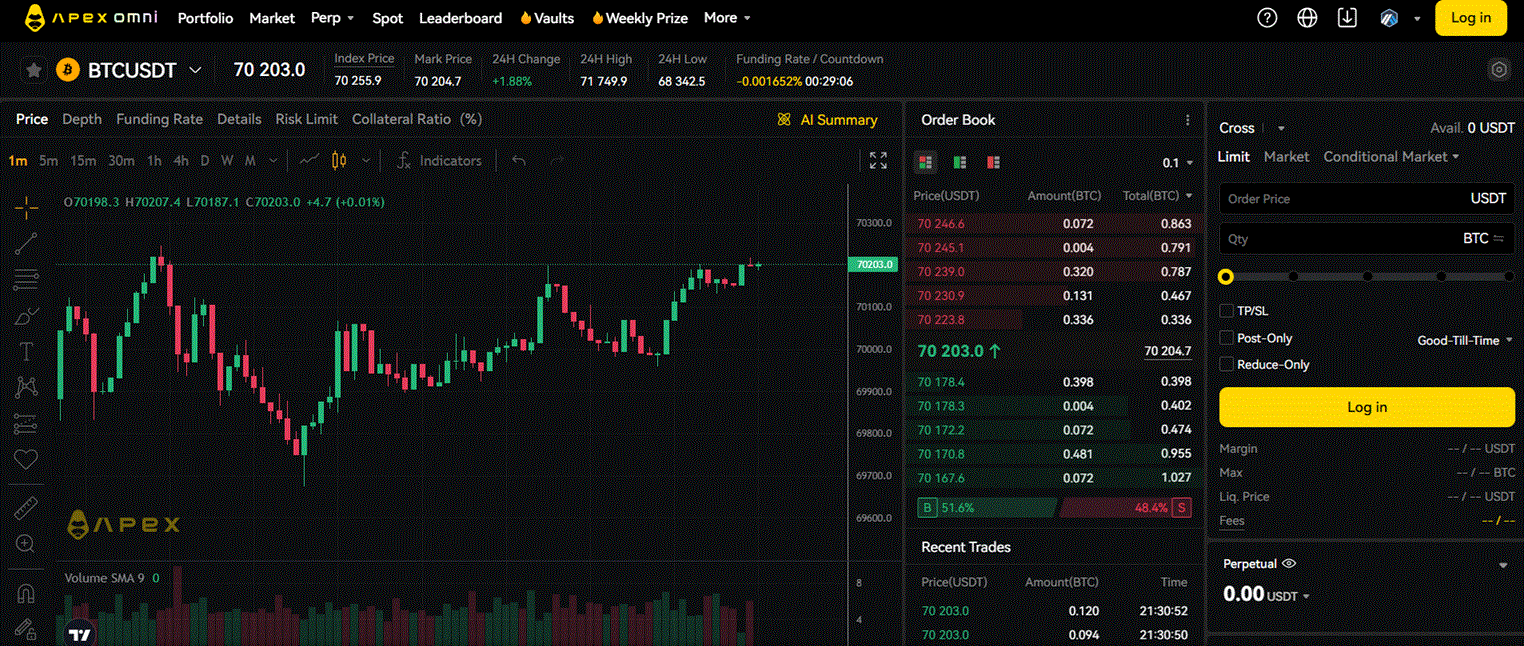
Apex Protocol is a decentralised perpetual exchange built on StarkEx — a battle-tested ZK-rollup developed by StarkWare and used by some of the most established DeFi protocols. It combines non-custodial trading with a cross-margin system that allows efficient capital deployment across multiple positions, and an interface that is among the cleanest in on-chain derivatives.
Apex has carved out a specific niche: it appeals to traders who want a sophisticated margin system and cross-chain deposit flexibility without sacrificing the self-custody guarantees of a decentralised platform. Its integration of both perpetuals and earn products within a single interface makes it a versatile platform for traders who want to put idle capital to work.
Affiliate disclosure: links to Apex on this page are affiliate links. We receive a commission if you open an account through them, at no cost to you. Our assessment is independent — see our affiliate policy.
The StarkEx Foundation
Apex is built on StarkEx — a ZK-rollup technology developed by StarkWare. StarkEx is not a general-purpose chain; it is a deployment-specific infrastructure used by dYdX (v3), Immutable X, Sorare, and Apex, among others.
The key properties inherited from StarkEx:
- ZK validity proofs: every batch of transactions is proven valid before being finalised on Ethereum. Invalid state transitions are mathematically impossible.
- Non-custodial by design: the StarkEx architecture guarantees that Apex cannot unilaterally freeze or confiscate funds — the smart contract enforces user control
- Ethereum settlement: final settlement occurs on Ethereum mainnet, with all the security that implies
- Forced withdrawal: if Apex were to cease operations, users can force-withdraw their funds directly via the Ethereum smart contract without Apex’s cooperation
The forced withdrawal mechanism is particularly important for traders who want to understand their worst-case scenario: even if Apex goes offline or the team disappears, funds are recoverable.
What Apex Offers
| Product | Details |
|---|---|
| Perpetual Futures | 80+ markets, up to 50× leverage on BTC/ETH, cross and isolated margin |
| Cross-Margin System | All positions share a single margin pool — capital efficient, higher risk if unmanaged |
| Multi-Chain Deposits | Deposit from Ethereum, Arbitrum, Optimism, Polygon, BSC, Avalanche and more |
| Apex Earn | Yield products for idle USDC — staking and structured earn options |
| API Trading | REST and WebSocket API for algorithmic strategies |
| APEX Token | Native governance and fee discount token |
The multi-chain deposit system is a genuine convenience advantage over platforms that require depositing from a specific chain. Traders holding USDC on Arbitrum, Optimism, or Polygon can deposit directly without bridging manually first — Apex handles the routing.
The Cross-Margin System
Apex’s cross-margin model is its most technically distinctive feature. In a cross-margin system, all open positions share a single collateral pool — unrealised profits on one position can be used as margin for another.
| Cross-Margin | Isolated Margin | |
|---|---|---|
| Collateral | Shared across all positions | Separate per position |
| Capital efficiency | High — unrealised profits available as margin | Lower — each position fully funded separately |
| Liquidation risk | A losing position draws from the entire account | Only the isolated position is at risk |
| Best for | Experienced traders managing a portfolio of positions | Beginners or traders wanting contained risk per trade |
Both modes are available on Apex — cross-margin is the default but positions can be set to isolated. For traders managing multiple concurrent positions across different assets, cross-margin is meaningfully more capital-efficient.
Fee Structure
| Market | Maker Fee | Taker Fee |
|---|---|---|
| Perpetuals (standard) | 0.02% | 0.05% |
| With APEX token staking | Down to 0.00% | Down to 0.03% |
Standard fees are competitive at 0.02% maker / 0.05% taker. Staking the APEX native token provides fee discounts, creating an incentive to hold and stake the token alongside using the platform.
Custody Model
Apex is fully non-custodial. Connect an EVM wallet, sign transactions with your key — Apex never holds custody of your private key. The StarkEx smart contract enforces this at the protocol level, not just through Apex’s policies.
Key distinctions from a typical CEX: – No account registration or KYC required – Withdrawals are processed by the smart contract — not approved by Apex – The forced withdrawal mechanism provides a recovery path independent of Apex’s continued operation
The APEX Token
APEX is the native governance and utility token of the Apex Protocol. Its uses:
- Fee discounts: staking APEX reduces trading fees on the platform
- Governance: APEX holders can vote on protocol parameters and treasury allocation
- Staking rewards: earned through staking in the protocol’s staking module
APEX has a defined maximum supply with a vesting schedule for team and investor allocations. Check the current circulating supply vs FDV on CoinGecko before taking a significant position in the token — the unlock schedule is a relevant consideration.
Who Should Use Apex
| Use Case | Recommendation |
|---|---|
| Experienced trader wanting cross-margin portfolio management on-chain | Strong recommendation — cross-margin system is best in class for DEXes |
| Multi-chain user wanting flexible deposit routing | Strong recommendation — widest chain support of the three DEXes covered here |
| Trader wanting StarkEx’s battle-tested ZK security | Strong recommendation — more mature ZK deployment than newer platforms |
| Algorithmic trader | Suitable — full API support |
| Trader prioritising raw liquidity depth | Hyperliquid currently has deeper liquidity on most pairs |
| New to DeFi / on-chain trading | Moderate — cross-margin requires understanding before use; start with isolated margin |
Apex vs Hyperliquid vs Lighter — How to Choose
| Apex | Hyperliquid | Lighter | |
|---|---|---|---|
| Architecture | StarkEx ZK-rollup | Custom L1 | ZK-rollup |
| Ethereum settlement | Yes | No (own L1) | Yes |
| Liquidity depth | Good | Best on-chain | Growing |
| Cross-margin | Yes — portfolio margin | Yes | Yes |
| Multi-chain deposits | Yes — 8+ chains | Arbitrum bridge | Limited |
| Forced withdrawal | Yes — StarkEx guarantee | No direct equivalent | Yes — ZK guarantee |
| Taker fee | 0.05% (0.03% with APEX) | 0.035% | 0.03% |
Key Takeaways
- Apex is built on StarkEx — a battle-tested ZK-rollup with Ethereum settlement and a forced withdrawal mechanism that protects users even if the platform ceases to operate
- The cross-margin system is the most sophisticated available on a DEX — efficient for experienced traders managing multiple concurrent positions, requires care for those new to portfolio margin
- Multi-chain deposit support (8+ chains) is the widest of the on-chain DEXes covered here — a meaningful convenience for traders with assets spread across chains
- Fees are competitive at standard tier and further reducible through APEX token staking
- No KYC, no custody risk beyond the bridge smart contract, fully recoverable via forced withdrawal
- For cross-margin portfolio trading and multi-chain flexibility: Apex. For raw liquidity and the best overall DEX execution: Hyperliquid. For ZK security at the lowest fees: Lighter.