Introduction
Bybit is one of the three largest crypto derivatives exchanges in the world by volume, alongside Binance and OKX. Founded in 2018, it has built its reputation primarily on the quality of its perpetual futures markets — deep liquidity, competitive fees, and a trading interface that appeals to both active retail traders and smaller institutional desks.
For traders coming from traditional finance who want centralised exchange infrastructure — familiar order types, a professional-grade interface, and reliable execution — Bybit is one of the strongest options currently available outside the US market.
Affiliate disclosure: links to Bybit on this page are affiliate links. We receive a commission if you purchase through them, at no cost to you. Our assessment is independent — see our affiliate policy.
What Bybit Offers
Bybit is a full-service centralised exchange. Its core offering is perpetual futures, but the platform has expanded significantly:
| Product | Details |
|---|---|
| Perpetual Futures | USDT-margined and inverse contracts, up to 100× leverage on BTC/ETH, 50× on major alts |
| Spot Trading | Hundreds of pairs with competitive spreads on major assets |
| Options | BTC and ETH options with European-style settlement |
| Bybit Earn | Staking, flexible savings, structured products — yield on idle holdings |
| Copy Trading | Follow and automatically replicate top traders’ positions |
| Launchpad | Early access to new token listings |
The breadth of products matters for a specific reason: capital efficiency. On Bybit, you can hold spot Bitcoin as collateral for a derivatives position while simultaneously earning yield on that collateral — a workflow that is not available across fragmented platforms.
Fee Structure
| Market | Maker Fee | Taker Fee |
|---|---|---|
| Spot | 0.10% | 0.10% |
| Perpetual Futures (standard) | 0.02% | 0.055% |
| Perpetual Futures (VIP tiers) | Down to 0.00% | Down to 0.02% |
Bybit uses a maker-taker model across all markets. Maker fees (limit orders that add liquidity) are significantly lower than taker fees (market orders that remove liquidity). For active traders, using limit orders where possible substantially reduces trading costs.
Fee discounts apply based on 30-day trading volume and VIP tier — professional-level traders at higher tiers access fees that are competitive with institutional prime brokerage rates.
Custody and Security
Bybit is a centralised exchange — your funds are held in Bybit’s custody when deposited. This is the fundamental risk of any CEX: if the exchange is hacked, insolvent, or experiences regulatory action, your assets may be at risk.
Bybit’s risk management measures:
- Cold storage: the majority of user funds are held in cold wallets, offline and air-gapped
- Proof of Reserves: Bybit publishes regular Proof of Reserves attestations — verifiable on-chain evidence that customer deposits are backed 1:1
- Insurance fund: maintains a large derivatives insurance fund to cover liquidation shortfalls, preventing the socialised loss mechanisms that affected earlier exchanges
- Two-factor authentication: mandatory 2FA and withdrawal address whitelisting available
Best practice: keep only the capital you need for active trading on Bybit. Long-term holdings belong in cold storage. The rule applies to every centralised exchange, regardless of reputation.
The Trading Interface
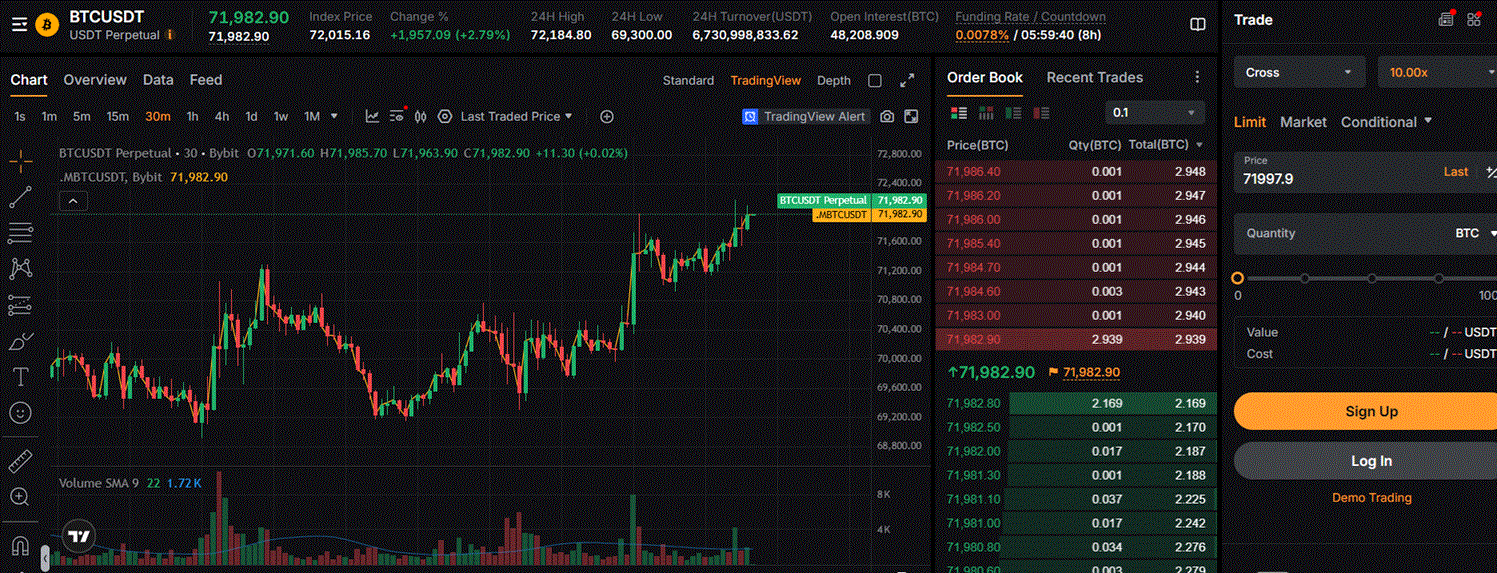
Bybit’s trading interface stands out for one feature in particular: native TradingView chart integration. The full TradingView toolkit — drawing tools, custom indicators, alerts — is available directly within Bybit’s trading view. For analysts who already use TradingView for research, this eliminates the friction of switching between a charting tool and an execution platform.
The mobile app is consistently rated among the best in class for derivatives trading — order management, position monitoring, and alerts are all functional on mobile without the compromises typical of exchange apps.
Availability and KYC
Bybit is not available to residents of the United States, the UK (for retail derivatives), and several other jurisdictions. KYC verification is required for full platform access — without verification, withdrawal limits apply.
For traders in eligible jurisdictions, the verification process is straightforward: government ID and a brief liveness check, typically approved within minutes.
Who Should Use Bybit
| Use Case | Recommendation |
|---|---|
| Active derivatives trader outside the US | Strong recommendation — depth, fees and interface are among the best available |
| Trader wanting TradingView integration in execution platform | Strong recommendation |
| Spot holder wanting yield on idle assets | Suitable — Bybit Earn is competitive |
| US-based trader | Not available — regulatory restriction |
| User wanting non-custodial trading | Not applicable — consider Hyperliquid or Lighter instead |
| Long-term holder | Not recommended for storage — use cold storage for anything beyond active trading capital |
Key Takeaways
- Bybit is one of the top three derivatives exchanges globally — deep liquidity, competitive fees and a polished interface make it a strong choice for active traders
- Native TradingView integration in the trading interface is a meaningful differentiator for analysts who use TradingView for research
- Centralised custody means counterparty risk — Proof of Reserves attestations and cold storage policies mitigate but do not eliminate this
- Fee structure rewards active traders: maker fees are among the lowest in the industry at standard tiers, with further reductions at higher volumes
- Not available in the US or UK retail derivatives market
- Keep only active trading capital on any CEX — store long-term holdings in cold storage