
Introduction
Every investor in crypto will experience significant drawdowns. Bitcoin has fallen 50–80% in every major bear market. Quality altcoins routinely drop 70–90% from their highs. Even in bull markets, corrections of 20–35% are normal and expected. The question is not whether you will face a drawdown — it is whether you have a framework for responding to it.
The three options available during a drawdown — hold, cut, or add — have radically different outcomes depending on which one is correct for the situation. Holding through a temporary correction is the right decision. Holding through a structural bear market is account destruction. Adding to a position during an accumulation bottom is the highest-return action available. Adding to a position that is in freefall is the fastest way to lose everything.
This article provides a framework for distinguishing between these scenarios — using cycle data, on-chain signals, and market structure to determine which response is appropriate — and the psychological principles that make it possible to execute the right decision when it is emotionally hardest to do so.
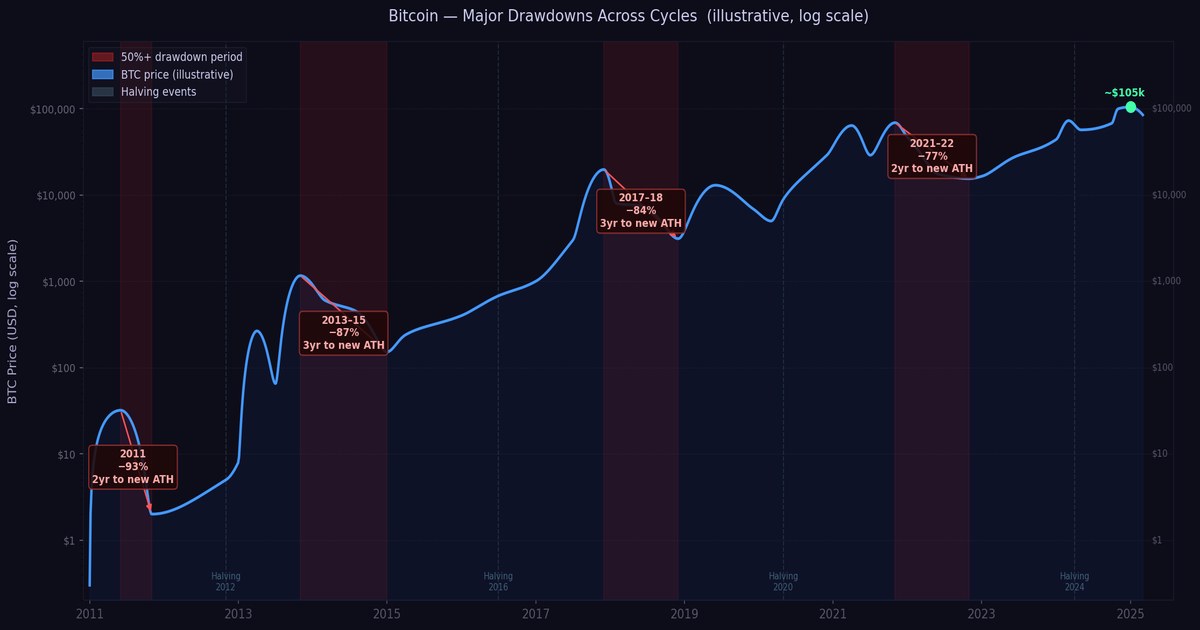
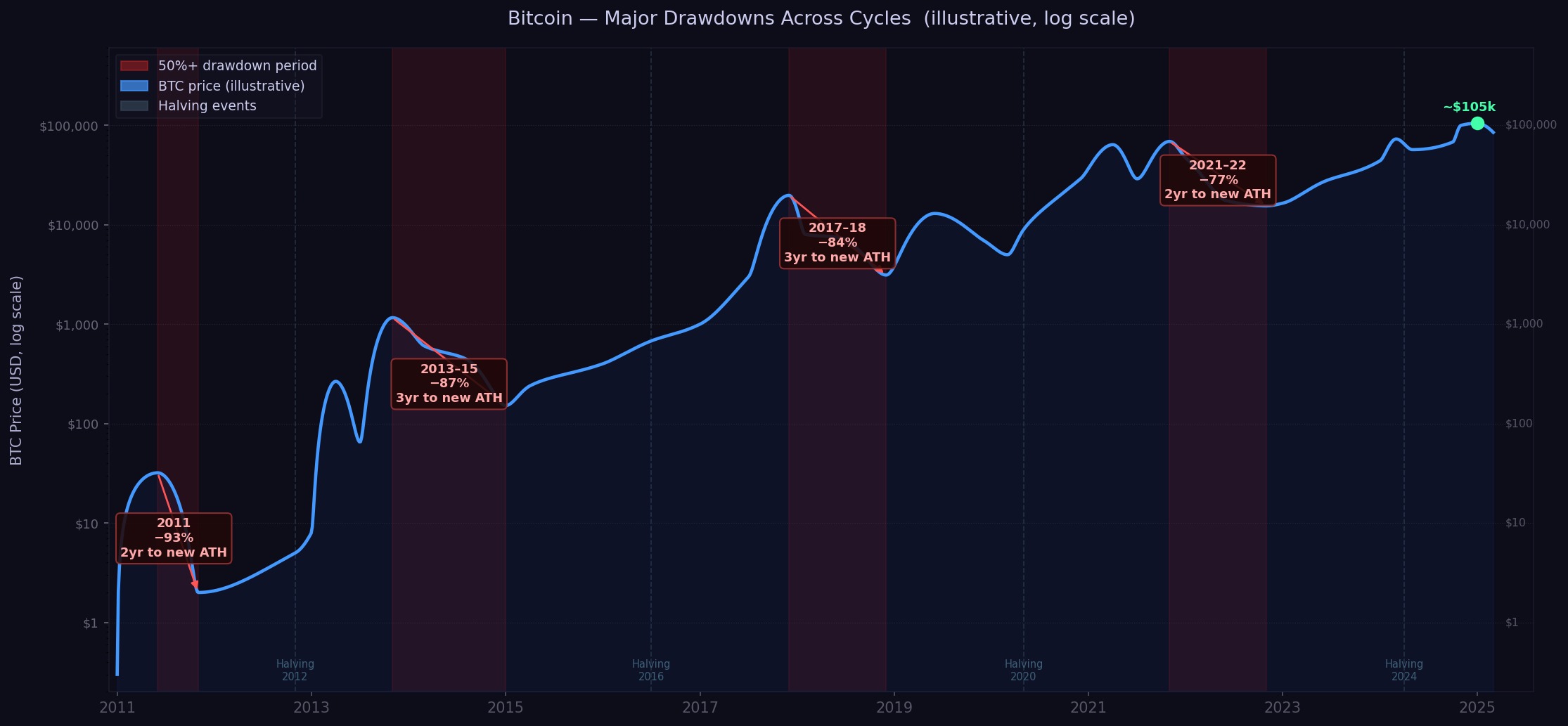
Three Types of Drawdown — The Diagnosis Comes First
Before deciding how to respond, you need to diagnose what type of drawdown you are in. The same 30% decline can be a buying opportunity or an early warning of a 70% loss — and the data determines which.
Type 1 — Bull Market Correction
A temporary pullback within an ongoing bull market. These are normal, expected, and have historically been optimal entry points for those who missed the initial move.
Characteristics: – Bitcoin still above its 200-day moving average – MVRV Z-Score below 4 (no macro overvaluation) – BTC dominance stable or slightly rising — capital consolidating, not exiting – Exchange flows neutral or net outflows (holders not rushing to sell) – Funding rates reset to neutral or slightly negative (long crowding cleared) – The decline is 20–35% from a recent high, not 50%+
Appropriate response: hold existing positions, consider adding to high-conviction holdings at a defined level.
Type 2 — Late-Cycle Distribution
A decline that begins while macro indicators are still elevated — the first leg down from a cycle top. This type of drawdown feels like a correction but is the beginning of a bear market.
Characteristics: – MVRV Z-Score was recently above 5–6 before the decline – LTH supply was falling (insiders distributing) before the price drop – BTC dominance beginning to rise as altcoins fall faster than Bitcoin – Funding rates normalising after an extended period of high positive funding – The decline accelerates rather than stabilising after the initial drop
Appropriate response: cut altcoin positions aggressively, reduce overall crypto allocation, shift toward Bitcoin and stablecoins. Do not add.
Type 3 — Bear Market Capitulation
A severe decline in an established bear market, often accompanied by panic selling and forced liquidations. These events are extremely painful but historically mark the best accumulation opportunities.
Characteristics: – Bitcoin below its 200-day moving average for an extended period – MVRV Z-Score below 1 (average holder underwater) – Puell Multiple below 0.5 (miners in distress) – Exchange inflows spiking (panic selling) – Funding rates negative (shorts paying longs — extreme bearish sentiment) – Broad capitulation visible in aSOPR well below 1.0 sustained
Appropriate response: begin systematic accumulation in stages. Do not try to catch the exact bottom — use a staged entry over weeks to months.
The Decision Framework
Once you have diagnosed the drawdown type, the response follows from the diagnosis. The challenge is that all three types feel similar emotionally — they all involve watching your portfolio fall. The data distinguishes them; emotions cannot.
| Signal | Bull Correction | Late-Cycle Distribution | Bear Capitulation |
|---|---|---|---|
| BTC vs MA200 | Above | Approaching or crossing below | Well below |
| MVRV Z-Score | 1–4 | Was above 5, now falling | Below 1 |
| LTH Supply | Stable or rising | Falling (distribution) | Rising (accumulation) |
| Exchange flows | Net outflows or neutral | Inflows increasing | Inflows spiking then fading |
| Altcoin vs BTC | Alts falling with BTC | Alts falling faster than BTC | Everything falling equally |
| Funding rates | Reset to neutral/negative | Collapsing from high positive | Negative |
| Response | Hold / add at levels | Cut / reduce | Accumulate in stages |
When to Hold
Holding is the correct response when the macro structure is intact and the drawdown is driven by temporary sentiment or technical factors rather than fundamental deterioration.
The conditions for holding are simple: Bitcoin above the 200-day MA, MVRV in the normal bull range, and on-chain data showing no significant LTH distribution. In this environment, selling into a correction locks in a loss and creates the psychological and practical problem of deciding when to re-enter — a decision most people get wrong.
The hold discipline: define, before the drawdown occurs, the specific conditions that would change your assessment from bull correction to something more serious. Write them down. When the drawdown happens, check the conditions — do not make the decision based on how the decline feels.
When to Cut
Cutting — reducing or closing positions — is the correct response when the evidence shifts from bull correction to late-cycle distribution or the beginning of a bear market.
The most important insight about cutting: the pain of cutting at the wrong time (selling a bull market correction) is recoverable — you re-enter at slightly higher prices. The pain of not cutting at the right time (holding through a bear market) can take years to recover from and may not be recoverable at all for altcoins that do not survive.
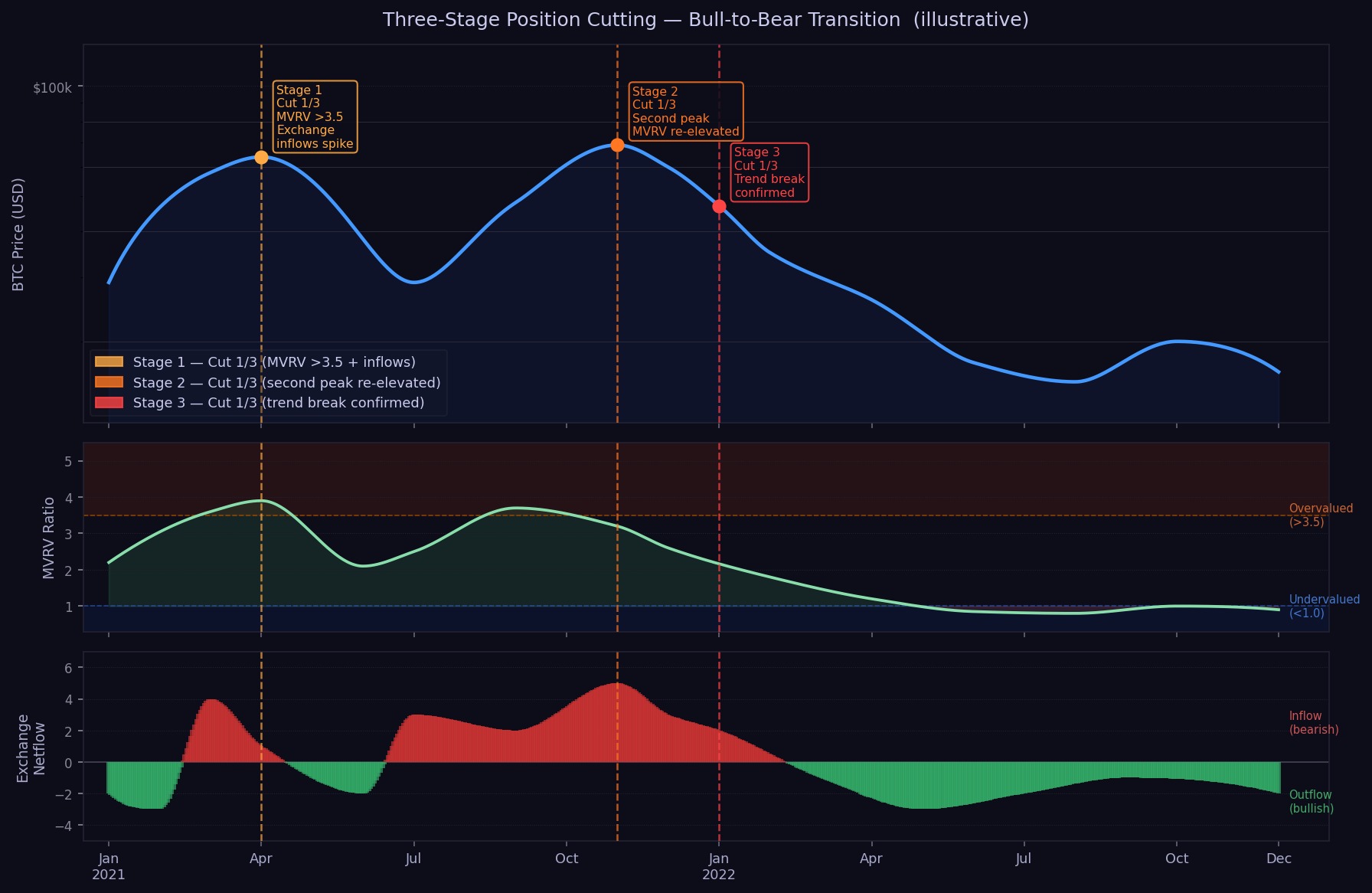
Cutting in stages: unless your stop has been hit (which triggers an immediate full exit as planned), consider cutting in three stages:
- First cut (25–33% of position): when two or more late-distribution signals appear — LTH supply falling, MVRV above 5, exchange inflows increasing. This is insurance, not conviction.
- Second cut (another 25–33%): when the decline accelerates after the initial drop, funding rates collapse from elevated levels, and altcoins underperform Bitcoin significantly.
- Final cut (remainder): when Bitcoin loses its 200-day MA on a weekly close. At this point, the bear market thesis is confirmed and the priority shifts to capital preservation.
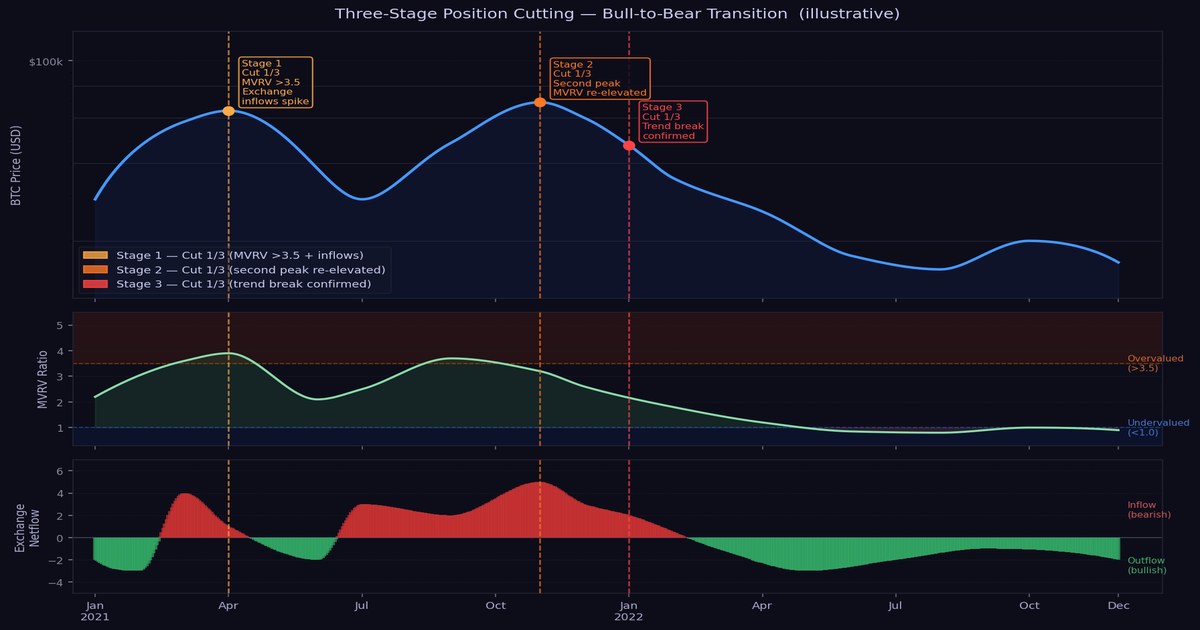
Staged cutting avoids the regret of selling the absolute top (impossible) while still protecting against the full depth of a bear market decline. Click to zoom.
When to Add
Adding to a position during a drawdown is the highest-return action available — and the most dangerous if done at the wrong time. The conditions for adding must be more stringent than the conditions for holding.
Adding during a bull correction
Requirements before adding: – All hold conditions are met (macro intact) – A specific technical level has been reached (a defined support, MA20 retest, prior breakout level) – Funding rates have reset to neutral or negative (short-term crowding cleared) – You have pre-defined how much you will add and at what price — not deciding in the moment
Do not add to a position simply because it has fallen. Add because the setup is better than it was before the decline — lower price, cleaner positioning, intact macro thesis.
Accumulating during bear market capitulation
Bear market accumulation is a different process from adding during a correction. The bottom cannot be identified in real time — only in retrospect. The correct approach is systematic and staged:
A practical accumulation structure:
| Stage | Trigger | Allocation |
|---|---|---|
| Stage 1 | MVRV Z-Score below 1 for the first time in this cycle | 25% of planned accumulation allocation |
| Stage 2 | Puell Multiple below 0.5 — miner stress confirmed | 25% |
| Stage 3 | aSOPR sustained below 1.0 — broad capitulation underway | 25% |
| Stage 4 | Bitcoin reclaims 200-day MA on weekly close — trend beginning to reverse | 25% |
This structure means you will never buy the exact bottom — Stage 4 triggers after a significant recovery from the low. You will also never put all your capital to work before the bottom is in. Both of these are acceptable outcomes. The goal is meaningful participation in the recovery at prices that are historically favourable, not perfection.
The Altcoin Problem — Not All Drawdowns Are Equal
The framework above applies most cleanly to Bitcoin. For altcoins, an additional factor must always be considered: some altcoins do not recover.
In every bear market, a significant percentage of tokens that peaked in the prior bull cycle fail to reach new all-time highs in the next one. Projects run out of funding, teams abandon development, competing protocols supersede them, or the narrative that drove their valuation simply does not return.
When deciding whether to hold, cut or add on an altcoin position in a drawdown, ask a harder question than you would for Bitcoin: does this project still have the team, funding, user base, and narrative to be relevant in the next bull cycle?
If the answer is no — or if you genuinely cannot assess it — the correct response is to cut and redeploy into Bitcoin, which has a 100% historical recovery rate from every prior drawdown.
The Psychological Layer
The framework described above is rational. Executing it is not — because drawdowns trigger loss aversion, sunk cost thinking, and the hope that a recovery will save the need to make a decision.
Three practices that make execution possible:
Pre-commitment: write down your hold, cut and add conditions before the drawdown occurs. When you are in the drawdown, you are consulting a document written by your rational self — not making a new decision under duress.
Separation of process and outcome: a good process can produce a bad outcome (you cut at the bottom before a recovery) and a bad process can produce a good outcome (you held through a bear market and it happened to recover quickly). Judge your decisions by whether the process was sound, not by whether the outcome was favourable.
The question that cuts through noise: when uncertain, ask — ”If I had no position right now, would I open one at this price, in this size, given everything I know?” If yes, hold. If no, cut. This removes the sunk cost bias from the decision.
Key Takeaways
- There are three types of drawdown — bull correction, late-cycle distribution, and bear capitulation — and each requires a different response; the data distinguishes them, emotions cannot
- The decision table: check BTC vs MA200, MVRV Z-Score, LTH supply, exchange flows, altcoin relative performance, and funding rates — the combination determines the response
- Holding is correct when macro structure is intact; define in advance the conditions that would change this assessment
- Cutting in three stages — at the first distribution signals, at the acceleration, and at the MA200 loss — avoids both premature selling and holding through a full bear market
- Accumulating in bear markets requires a staged structure tied to specific on-chain triggers, not a price level — the bottom is never identifiable in real time
- For altcoins, always ask whether the project will be relevant in the next cycle — if the answer is uncertain, the correct default is to cut and hold Bitcoin instead
- Pre-commitment — writing hold, cut and add conditions before the drawdown — is the most practical tool for executing the right decision when it is emotionally hardest