
Introduction
Most traders spend the majority of their time on entry decisions — which asset, which direction, which price level. Position sizing receives a fraction of that attention. This is backwards. The entry determines which opportunities you capture. Position sizing determines whether those opportunities build your account over time or destroy it in a single bad week.
In traditional markets, position sizing is well-understood: volatility-adjusted models, fixed fractional methods, and Kelly criterion variants are standard tools. In crypto, the same principles apply — but the parameters are different. Bitcoin regularly moves 10–20% in a week. Altcoins can move 50–80% in either direction within a month. A position size that is appropriate for equities will produce catastrophic losses in crypto.
This article covers four position sizing frameworks adapted for crypto volatility, how to adjust size based on conviction and cycle position, and the practical rules that prevent any single trade from being account-threatening — regardless of how wrong you turn out to be.
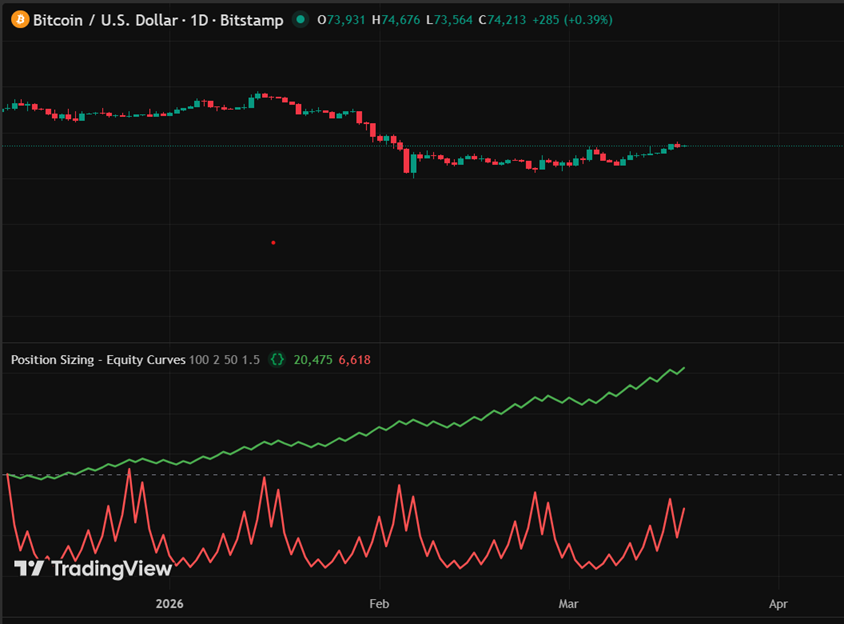
The Core Principle — Survive First, Profit Second
Before covering specific frameworks, one principle underlies all of them: no single trade should threaten your ability to continue.
This is not a conservative sentiment — it is a mathematical reality. A 50% loss requires a 100% gain to recover. A 75% loss requires a 300% gain. In practice, large losses do more than reduce capital — they reduce psychological capacity to trade well, create pressure to recover quickly (which leads to further oversizing), and often coincide with the worst market conditions for new entries.
The goal of position sizing is not to maximise the return on any individual trade. It is to remain in the game long enough for your edge — if you have one — to express itself across a large number of trades.
Framework 1 — Fixed Percentage Risk
The simplest and most robust framework. Before entering any trade, define the maximum amount of capital you are willing to lose on that specific trade, expressed as a percentage of total portfolio value.
Standard risk parameters for crypto:
| Risk per Trade | Suitable for | Consecutive losses to lose 50% of account |
|---|---|---|
| 0.5% | High-frequency setups, lower conviction | 139 losses in a row |
| 1% | Standard risk unit — most active traders | 68 losses in a row |
| 2% | High-conviction setups only | 34 losses in a row |
| 5% | Maximum — exceptional setups, experienced traders | 13 losses in a row |
For most crypto traders, 1% per trade is the appropriate standard risk unit. This means that if your stop is hit — no matter how confident you were — you lose 1% of your total portfolio. Not 1% of your position. 1% of everything you have.
How to calculate position size from a fixed risk:
- Determine your stop level (the price at which you are wrong)
- Calculate the distance from entry to stop as a percentage
- Divide your risk amount by that distance
Example: $50,000 portfolio, 1% risk = $500 maximum loss. Entry at $100, stop at $90 (10% below). Position size = $500 / 10% = $5,000 (10% of portfolio in this trade).
If the stop is tighter — say, $95 (5% below entry) — the same $500 risk produces a $10,000 position (20% of portfolio). Tighter stops allow larger positions for the same risk. This is why stop placement and position sizing must be decided together, never separately.
Framework 2 — Volatility-Adjusted Sizing
Fixed percentage risk works well when stop distances are consistent. In crypto, they rarely are — Bitcoin at low volatility might warrant a 5% stop, while the same setup during a high-volatility period might require a 15% stop to avoid being stopped out by noise.
Volatility-adjusted sizing addresses this by scaling position size inversely with the asset’s current volatility.
A practical approach using ATR (Average True Range):
- Calculate the 14-day ATR of the asset — this represents its average daily price range
- Set your stop at 1.5× to 2× the ATR below your entry (giving the trade room to breathe)
- Apply the fixed percentage risk calculation to determine position size
Effect: when volatility is high (large ATR), stops are wider and positions are smaller. When volatility is low (small ATR), stops are tighter and positions can be larger. The risk per trade in dollar terms remains constant; the position size fluctuates with market conditions.
This approach automatically reduces exposure during high-volatility periods — precisely when the risk of a large loss is highest — and increases it during low-volatility periods when the risk is lower.
Framework 3 — Conviction-Scaled Sizing
Not all setups are equal. A position at a confluence of multiple signals (on-chain, technical, derivatives all aligned) deserves a larger size than a setup based on a single indicator. Conviction-scaled sizing formalises this intuition.
Define three tiers:
| Tier | Conditions | Risk Multiplier | Example (1% base risk) |
|---|---|---|---|
| Tier 1 — Full conviction | 3+ independent signals aligned, macro cycle supportive, low derivatives crowding | 1.5× to 2× | 1.5–2% risk |
| Tier 2 — Standard conviction | 2 signals aligned, macro cycle neutral, normal derivatives conditions | 1× | 1% risk |
| Tier 3 — Speculative / exploratory | 1 signal, contrarian setup, or high-uncertainty environment | 0.5× | 0.5% risk |
The key discipline: decide the tier before entering the trade, not after it starts moving in your favour. Position sizing decisions made while in a winning trade are almost always too large.
Framework 4 — Portfolio Allocation by Cycle Position
Individual trade sizing determines the risk per position. Portfolio-level allocation determines how much of your total capital is in crypto at all — and within crypto, how it is distributed across asset types.
Cycle position should directly influence total allocation:
| Macro Stance | Total Crypto Allocation | BTC/ETH vs Altcoins |
|---|---|---|
| Accumulation (MVRV below 1, bear market) | 30–50% of investable capital | 80–90% BTC/ETH, 10–20% high-quality alts |
| Position-building (MVRV 1–4, early bull) | 50–70% | 60–70% BTC/ETH, 30–40% alts |
| Selective / neutral (MVRV 4–6, mid bull) | 60–80% | 50% BTC/ETH, 50% sector-leading alts |
| Distribution (MVRV above 6, late bull) | 30–50%, actively reducing | 70–80% BTC/ETH or stablecoins, minimal small-caps |
The altcoin allocation should itself be distributed across multiple positions — never more than 10–15% of total portfolio in a single altcoin, regardless of conviction. Altcoin-specific risks (rug pulls, protocol exploits, founder exits, token unlocks) are not captured by market analysis and can send a token to zero regardless of macro conditions.
Adjusting for Crypto-Specific Risks
Standard position sizing frameworks assume that losses are bounded by your stop. In crypto, several scenarios can bypass stops entirely:
Weekend gaps and flash crashes: crypto trades 24/7, but liquidity thins significantly on weekends and during off-hours. A flash crash can gap through a stop level, executing at a much worse price.
Exchange risk: funds held on an exchange carry counterparty risk — exchange insolvency or a hack can result in losses that no stop can protect against. Keep only the capital you need for active trading on exchanges; hold long-term positions in self-custody.
Smart contract risk: DeFi protocol exploits can drain positions to zero instantly. Size DeFi positions more conservatively than CEX positions — treat the protocol risk as an additional risk factor that reduces your maximum position size.
Liquidity risk in altcoins: small-cap altcoins may have insufficient liquidity to execute a stop at the stated price. For illiquid tokens, widen your effective stop assumption when calculating position size — assume execution at 10–20% worse than the stated stop level.
The Rules That Actually Matter
Frameworks are useful. Discipline is what makes them work. These five rules, applied consistently, prevent the position sizing mistakes that end accounts:
1. Never add to a losing position to average down. The market is telling you something. Averaging down converts a manageable loss into a portfolio-threatening one.
2. Decide stop and size before entry, never after. Moving stops to avoid a loss is not risk management — it is hope management. The stop must be decided when you are objective, not when you are anxious.
3. Maximum correlation limit. If three of your altcoin positions are all in the AI sector, they will all move together in a risk-off event. Treat highly correlated positions as a single position for sizing purposes.
4. Total portfolio leverage limit. In aggregate, the dollar value of all open positions should not exceed 2× total portfolio value. Above this level, a 50% market crash produces a margin call — a forced exit at the worst possible time.
5. The 1% rule as a floor, not a target. On days when conditions are uncertain, market structure is unclear, or you are not thinking clearly — size down to 0.5% or below. The market will be there tomorrow.
Key Takeaways
- Position sizing determines whether your edge survives long enough to compound — more important than entry decisions, less discussed
- Fixed percentage risk (1% per trade as a standard unit) is the most robust starting framework — calculate from the stop distance, not from a round lot size
- Volatility-adjusted sizing scales position size inversely with ATR — automatically reducing exposure during high-volatility periods
- Conviction-scaled sizing formalises the intuition that not all setups are equal — tier the risk multiplier before entering, never after the trade is moving in your favour
- Portfolio-level allocation should reflect macro cycle position: maximum crypto exposure in accumulation, managed reduction beginning in the late bull
- Crypto-specific risks (gaps, exchange risk, smart contracts, illiquidity) require additional conservatism beyond what standard frameworks assume — build these into your sizing as additional risk factors