Introduction
Every asset that exists in the financial system today — government bonds, corporate credit, real estate, private equity, infrastructure — can, in principle, be represented as a token on a blockchain. That token can be transferred, settled and held 24 hours a day, seven days a week, by any counterparty with a compliant digital wallet, without the T+2 settlement cycle, the intermediary chain or the paper-based documentation that currently slows the process.
This is not a theoretical proposition. Tokenised real-world assets (RWAs) represent one of the fastest-growing segments of on-chain finance, with total value locked in tokenised assets crossing $15 billion in 2025 and growing rapidly across asset classes. The institutions issuing these products are not startups — they are BlackRock, Franklin Templeton, JPMorgan and Société Générale.
For portfolio managers and ALM strategists, the relevant question is not whether this technology works. It is how it changes the portfolio construction toolkit — and whether the advantages in yield, liquidity and operational efficiency are material enough to act on.
What Tokenisation Actually Means
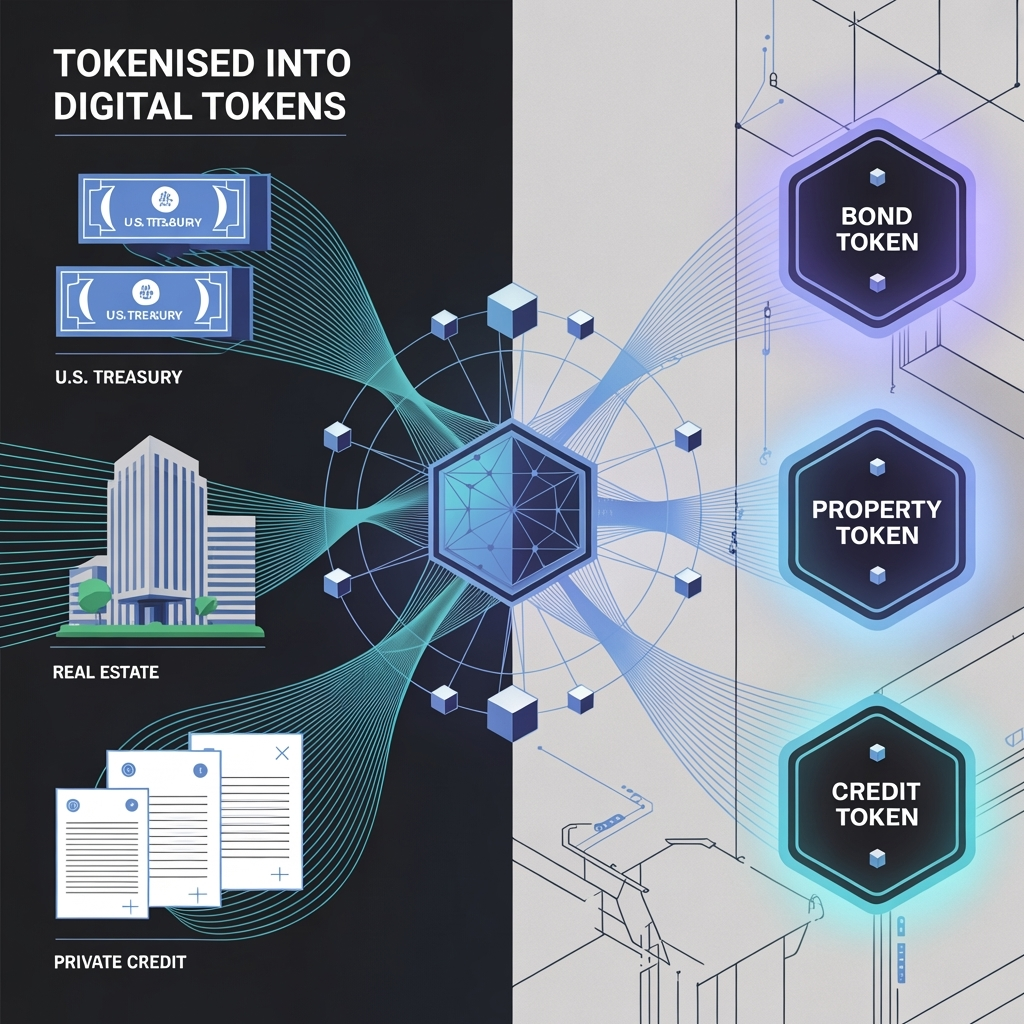
Tokenisation is the process of creating a digital representation of an asset — or a claim on an asset — on a blockchain. The token does not replace the underlying asset. It represents ownership, or a beneficial interest, in that asset.
A tokenised US Treasury bill is backed by actual T-bills held in a regulated custodial structure. A tokenised corporate bond represents a claim on the same coupon and principal as the traditional bond. A tokenised real estate fund share entitles the holder to the same economic interest as a traditional fund unit.
What changes is the settlement infrastructure: tokens can be transferred in minutes rather than days, fractionalised to smaller minimum denominations, held in digital wallets alongside other assets, and programmed to execute actions automatically (coupon payments, corporate actions) via smart contracts.
The analogy to the equity market is useful: the shift from physical share certificates to dematerialised book-entry securities in the 1980s and 1990s did not change the economics of equity ownership — it radically improved operational efficiency. Tokenisation is the next iteration of the same process.
Tokenised Government Bonds: Already Operational
The most mature segment of the RWA market is tokenised government bonds — primarily US Treasuries.
BlackRock BUIDL (USD Institutional Digital Liquidity Fund) launched in March 2024 on the Ethereum blockchain. The fund invests in US Treasury bills, cash and repurchase agreements — identical to a money market fund — but issues shares as tokens on-chain. Institutional investors holding BUIDL receive daily yield accrual directly to their wallets. The fund crossed $500 million in AUM within weeks and $1 billion within months. Minimum investment: $5 million.
Franklin Templeton BENJI operates on both Stellar and Polygon blockchains. The fund invests in US government securities and money market instruments, with shares represented as on-chain tokens. Settlement is near-instant, and shares can be transferred between wallets 24/7. The fund has been operational since 2021 — one of the longest track records in the space.
Ondo Finance OUSG provides on-chain exposure to BlackRock’s short-duration bond ETF, tokenised and made accessible to institutional investors with lower minimum thresholds than the direct fund. Ondo has become one of the largest RWA protocols by AUM.
For treasury managers and fixed income allocators, the appeal is clear: money market fund economics with T+0 settlement and 24/7 liquidity, held alongside other digital assets in a single custody structure.
Corporate Credit and Private Markets
Beyond government bonds, tokenisation is beginning to address the operational friction in private credit and corporate bond markets — which are significantly more complex to settle and transfer than government securities.
Société Générale Forge has issued multiple tranches of tokenised covered bonds on the Ethereum blockchain, denominated in euros. These instruments are recognised under French securities law and settle on-chain with the same legal standing as traditional covered bonds.
Hamilton Lane, one of the largest private markets asset managers globally, has tokenised feeder funds providing access to its flagship private equity and credit strategies. Tokenisation in this context solves a specific problem: private market fund interests have traditionally been highly illiquid, with transfers requiring lengthy legal processes. On-chain tokens allow secondary transfers in a fraction of the time.
Apollo Global Management and KKR have both participated in tokenisation pilots for private credit vehicles, recognising that the addressable market for tokenised private markets is enormous — the majority of the $12 trillion private markets industry is currently inaccessible to all but the largest institutional investors due to high minimums and operational complexity.
Tokenised Real-World Asset Products — Active Examples (2026)
| Product | Issuer | Asset Class | Blockchain | AUM (approx.) | Min. Investment |
|---|---|---|---|---|---|
| BUIDL | BlackRock / Securitize | US Treasuries / MMF | Ethereum | $1B+ | $5M |
| BENJI | Franklin Templeton | US Gov. Securities | Stellar, Polygon | $500M+ | Low |
| OUSG | Ondo Finance | Short-duration bond ETF | Ethereum, Solana | $400M+ | $100K |
| Tokenised Covered Bond | Société Générale Forge | Covered bonds (EUR) | Ethereum | Undisclosed | Institutional |
| Hamilton Lane SCOPE | Hamilton Lane | Private equity / credit | Polygon | Growing | $10K |
Source: Company disclosures, RWA.xyz, DeFiLlama 2025–2026 data
How RWAs Fit Into a Traditional Portfolio Framework
For a portfolio manager running a standard allocation, the question is where tokenised assets add value relative to their traditional equivalents.
In a 60/40 portfolio context:
The fixed income sleeve is the most immediate application. Tokenised T-bills and money market funds provide the same yield as their traditional equivalents, with superior liquidity (24/7 vs T+2) and lower operational overhead. For portfolios that need to maintain a liquid buffer — for redemptions, rebalancing or margin management — tokenised money market funds are operationally superior to traditional alternatives.
The equity sleeve is earlier in development, but tokenised private equity and venture fund access represents a genuine expansion of the investable universe — particularly for smaller institutional allocators who currently lack access to top-tier private market managers.
In an ALM context:
Liability-driven investors (pension funds, insurance companies) have specific requirements around duration matching, cash flow certainty and regulatory capital treatment. Tokenised fixed income assets can, in principle, address all of these — but the regulatory and accounting treatment remains jurisdiction-dependent and requires careful legal analysis.
The most immediate ALM application is in the collateral and liquidity management function: tokenised high-quality liquid assets (HQLA) that can be transferred 24/7 to meet margin calls or liquidity requirements without the T+2 delay that creates operational stress in volatile markets.
On-chain yield vs traditional equivalents:
One of the more compelling data points for fixed income allocators: on-chain stablecoin lending rates on platforms like AAVE have historically tracked, and in some periods exceeded, money market rates — while remaining fully collateralised and transparent. The yield differential is not always positive, but it is real and measurable.
The Operational and Legal Landscape
Tokenisation does not eliminate operational complexity — it relocates it. The key considerations for institutional adoption:
Legal title and bankruptcy remoteness: In most jurisdictions, the token does not itself confer legal title to the underlying asset. The legal structure wrapping the token — the SPV, trust or fund — determines the investor’s actual rights. This requires careful legal review in each jurisdiction.
Custody: Tokenised assets require digital asset custody infrastructure in addition to (or instead of) traditional custody. Regulated custodians including BNY Mellon, Fidelity Digital Assets and Anchorage Digital now support tokenised securities custody.
Regulatory treatment: The accounting and regulatory capital treatment of tokenised assets is still evolving. In the EU, MiCA covers most aspects of tokenised asset issuance. In the US, the SEC and OCC have provided guidance but the framework is not yet fully harmonised with existing securities law.
Interoperability: Different tokenised assets sit on different blockchains. The ability to move assets seamlessly across chains — for collateral, settlement and portfolio management — is improving rapidly but is not yet seamless. Cross-chain bridges and standards like ERC-1400 (security tokens) are the infrastructure being built to address this.
The Trajectory
The Boston Consulting Group has estimated that the tokenised asset market could reach $16 trillion by 2030. Whether or not that specific number proves accurate, the direction is clear: every major financial infrastructure provider — clearinghouses, custodians, exchanges, asset managers — is building tokenisation capabilities.
The institutions that understand RWA infrastructure today will be better positioned to serve clients, structure products and manage portfolios in the market that emerges. The institutions that defer this learning will face a steeper catch-up curve.
Key Takeaways
- Tokenised real-world assets represent traditional financial instruments (bonds, credit, real estate) held on blockchain infrastructure
- BlackRock BUIDL, Franklin Templeton BENJI and Ondo Finance are the benchmark products in tokenised government bonds
- Société Générale, Hamilton Lane, Apollo and KKR are active in tokenised corporate credit and private markets
- For portfolio managers: immediate applications in money market / liquidity management; longer-term applications in private markets access and ALM
- Legal, custody and regulatory frameworks are developing rapidly — the barriers are lower than they were two years ago
Next: A practical guide to building your first institutional crypto portfolio — custody options, asset allocation approaches and risk frameworks used by professional allocators today.